|
Journal Papers |
Books and Book Chapters |
Conference Proceedings
Due to journal ownership of copyrights, I have not posted pdf copies of the papers here. Instead, I have posted links to the journal sites, which should work if your institution has access. If you cannot obtain an article via the link, I will be happy to send it to you upon request: contact me at smela@umd.edu.
Paper
Topic Code:
|
act = actuation
CP = conjugated polymer
DEA = dielectric elastomer
DEP = dielectrophoresis
nast = fluidic nastic actuators
sens = sensing
cell = cell-based sensors
piezo = piezoresistive sensors
FO = fiber optic
|
EIT = electrical impedance tomography
LC = liquid crystal
MEMS = fluid = microfluidics
PCR = 2D PCR
PLED = polymer light emitting diode
SAM = self-assembled monolayer
stretch = compliant electrodes |
Click on Year to sort by year, and click on Code to sort by the paper topic codes given above.
| Year |
Code |
Citation |
2022 |
EIT |
 E. Smela
Eng. Res. Expr., 4(4), 045041, (2022)
[Abstract]
direct link to PDF on IOP site
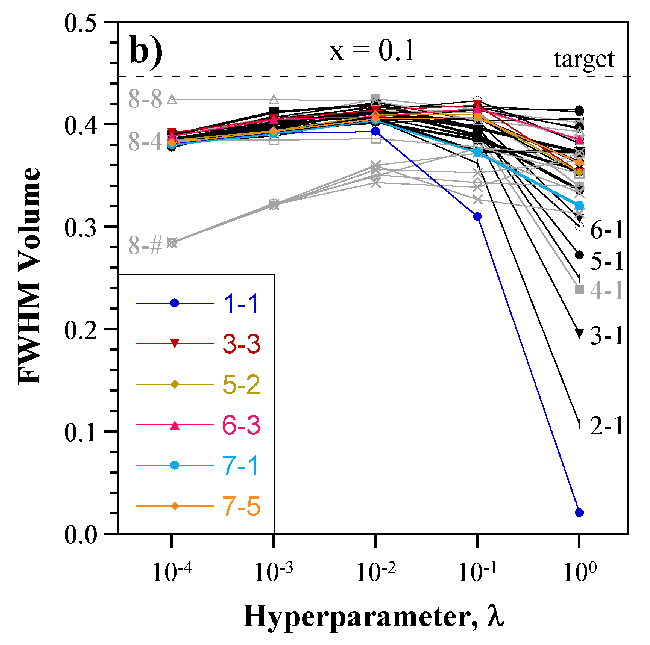
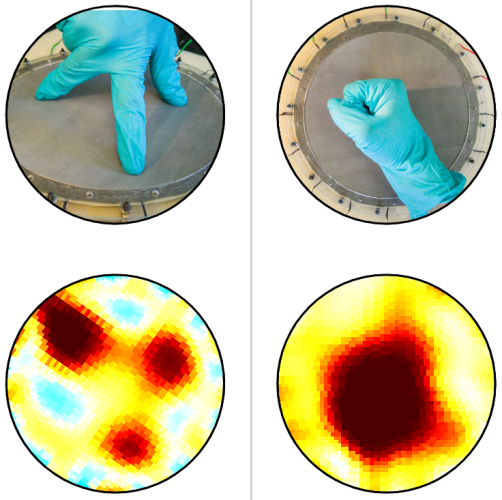
Bipolar current injection and voltage measurement (I–M) patterns are frequently used in electrical impedance tomography (EIT) for tactile sensing. In this work, the total set of 36 unique combinations for 16-electrode systems is investigated using simulations. Performance is evaluated on a circular sensor as a function of hyperparameter and target position with respect to critical performance measures for tactile sensing; these include not only peak amplitude and resolution, but also susceptibility to noise and, importantly, the uniformity of performance over the sensor area. The determination of which pattern to employ can therefore be based on the needs of the particular application. The relative performance of the I–M patterns is determined at small hyperparameters by electrode placement symmetry, but at large hyperparameters by sensitivity at the center of the sensor. Patterns with high spatial symmetry should be avoided; these include electrode pairs on opposite sides of the sensor. Patterns with electrodes in adjacent positions, which have been the norm for tactile sensing, should also not generally be used. If performance on all metrics across a wide range of hyperparameters is needed, then placing both the injection and measurement electrodes 3 spaces apart (the 3–3 pattern) can be a good strategy for the Gauss-Newton 1-step algorithm with the Laplacian prior. The use of 13 electrodes instead of 16 is also examined. The absence of symmetry provides greater flexibility in the choice of I–M pattern, and the loss in performance may be small; furthermore, the reduction in data collection time may be advantageous. Beyond avoiding the worst I–M patterns, the most important measure to take is decreasing noise on the signal to permit the use of a smaller hyperparameter; this is of greater importance than selecting from among the remaining I–M patterns.
|
2022 |
EIT |
 E. Smela
Eng. Res. Expr., 4(3), 035057, (2022)
[Abstract]
direct link to PDF on IOP site
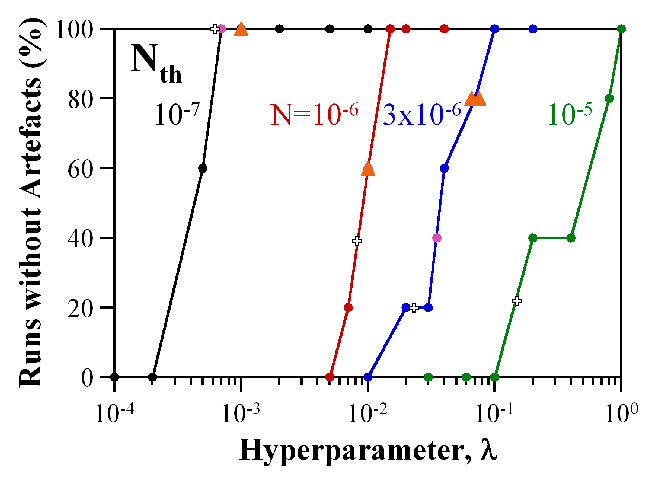
Electrical impedance tomography (EIT) is employed in tactile sensing to create an image of impedance changes within a continuous sensor using electrodes placed only at the perimeter. Noise destabilizes EIT images, and the onset of instability is associated with the appearance of artefacts, which are spurious image features that are not associated with sensor responses to contacts. Artefacts are detrimental because the essential features of contacts, or targets, must be correctly represented, including how many there are and their approximate shapes and locations, yet their presence has not previously been used as a performance measure. Regularization, the extent of which is determined by the hyperparameter lambda, is used to manage the destabilization, but it results in spatially non-uniform defocusing of image features. We therefore introduce an efficient criterion for evaluating tactile sensor image quality based on the onset of artefacts. Using simulated data and the one-step Gauss-Newton reconstruction algorithm with the Laplace prior, the noise level at which artefacts first appear at a given hyperparameter, or noise threshold Nth(lambda), is found. How the relationship depends on target characteristics and other factors is shown, and Nth can vary by orders of magnitude. The conceptually similar BestRes method and the classical L-curve and generalized cross-validation (GCV) methods for determining an optimal hyperparameter are evaluated using the criterion of artefact-free images. The L-curve generates hyperparameters that are well matched to the onset of artefacts, except at high noise; the other two result in artefacts. For high dynamic range tactile inputs, setting the threshold at a fixed value using a method such as Nth is not advisable, and automatic regularization tailored to the input may be needed using a method such as the L-curve or GCV, provided that the computational overhead is tolerable.
|
2019 |
sens-cell |
 B. P. Senevirathna, S. Lu, M. Dandin, E. Smela, and P. Abshire
IEEE Trans. Biomed. Circ. Syst., 13(6), 1214-1225, (2019)
[Abstract]
direct link to PDF on IEEE site
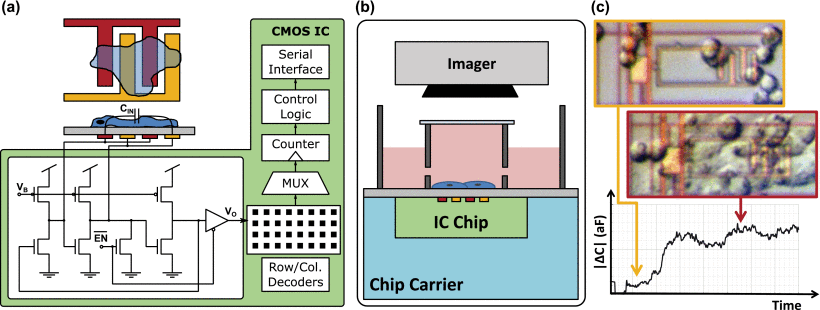
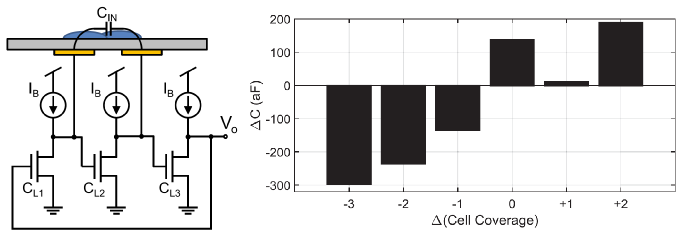
We present a capacitance sensor chip developed in a 0.35 µm CMOS process for monitoring biological cell viability and proliferation. The
chip measures cell-to-substrate binding through capacitance-to-frequency conversion with a sensitivity of 590 kHz/fF. In vitro experiments with two human ovarian cancer cell
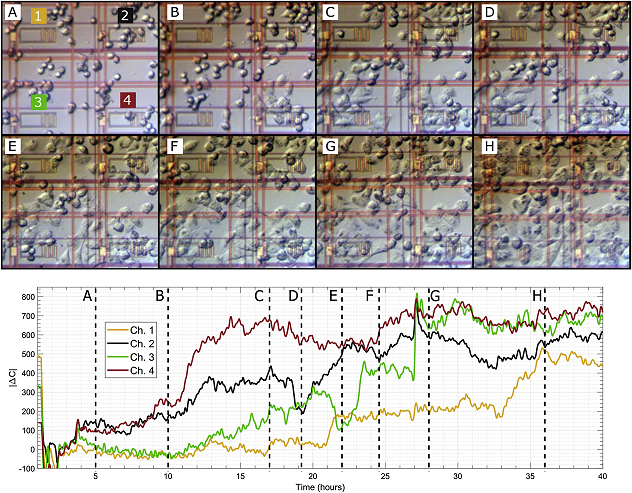
lines (CP70, A2780) were performed and showed the ability to track cell viability in real-time over three days. An imaging platform was developed to provide time-lapse images
of the sensor surface, which allowed for concurrent visual and capacitance observation of the cells. Results showed the ability to detect single cell binding events and changes
in cell morphology. Image processing was performed to estimate cell coverage of sensor electrodes, showing good linear correlation and providing a sensor gain of 1.28 ± 0.29
aF/µm2, which agrees with values reported in literature. The device is designed for unsupervised operation with minimal packaging requirements. Only a microcontroller is
required for readout, making it suitable for applications outside the traditional laboratory setting.
|
2019 |
sens-cell |
 B. Senevirathna, S. Lu, M. Dandin, J. Basile, E. Smela, and P. Abshire B. Senevirathna, S. Lu, M. Dandin, J. Basile, E. Smela, and P. Abshire
Biosens. Bioelectron. 142, 111501, DOI https://doi.org/10.1016/j.bios.2019.111501 (2019)
[Abstract]
direct link to PDF on Science Direct
Monitoring cell viability and proliferation in real-time provides a more comprehensive picture of the changes cells undergo during their lifecycle than can be achieved using traditional end-point assays. Particularly for drug screening applications, high-temporal resolution cell viability data could inform decisions on drug application protocols that might lead to better treatment outcomes. We describe a CMOS biosensor that monitors cell viability through high-resolution capacitance measurements of cell adhesion quality. The system consists of a 3 × 3 mm2 chip with an array of 16 sensors, on-chip digitization, and serial data output that can be interfaced with inexpensive off-the-shelf components. An imaging system was developed to provide ground-truth data of cell coverage concurrently with data recordings. Results showed the sensor's ability to detect single-cell binding events, track cell morphology changes, and monitor cell motility. A chemotherapeutic assay was conducted to examine dose-dependent cytotoxic effects on drug-resistant and drug-sensitive cancer cell lines. Concentrations higher than 5 µM elicited cytotoxic effects on both cell lines, while a dose of 1 µM allowed discrimination of the two cell types. The system demonstrates the use of real-time capacitance measurements as a proof-of-concept tool that has potential to hasten the drug development process.
- email me for copy if no access
through your institution |
2019 |
sens-piezo |
 A. Ramadan, A. Roy, and E. Smela A. Ramadan, A. Roy, and E. Smela
IEEE J. Trans. Eng. Health Med. 7(1-3), DOI: 10.1109/JTEHM.2019.2942922, (2019)
[Abstract]
direct link to PDF on IEEE site
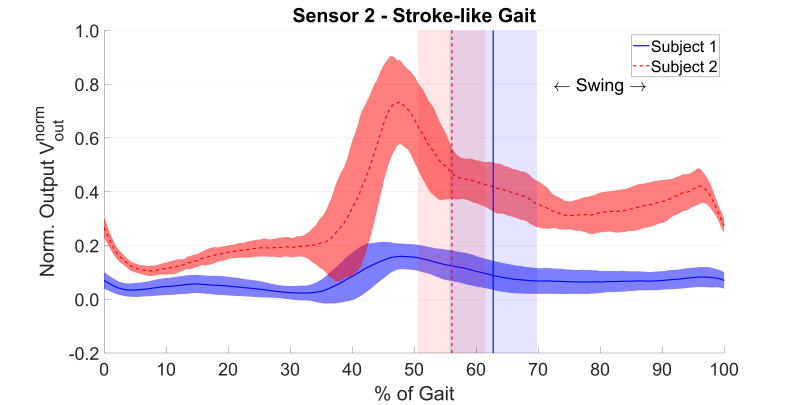
Objective: To provide proof-of-concept for a novel method to recognize impaired push-off and foot-drop deficits in hemiparetic gait
using analog pressure sensors. These data may enhance feedback from a modular ankle exoskeleton (such as Anklebot) for stroke rehabilitation, which now employs on/off foot
switches under the foot. Methods: A pressure sensor was positioned on the posterior side of the calcaneus. Experiments were conducted on two healthy subjects with normal
walking and with hip circumduction and foot drop, the latter to mimic hemiparetic gait post-stroke. Results: Unlike the foot switches, the pressure sensor yielded data during
swing. The initial swing and terminal stance readings followed local foot-shoe dynamics and were thus able to detect foot drop swing deficits while also providing push-off
information during stance. Discussion: The analog pressure sensors provided more information than foot switches, even during stance. This system may provide clinicians with a
tool to monitor foot drop and push-off. |
2018 |
sens-piezo |
 Y. Chen, M. Yu, H. A. Bruck, and E. Smela Y. Chen, M. Yu, H. A. Bruck, and E. Smela
Smart Mater. Struct. 27 (12), 125009, DOI: 10.1088/1361-665X/aaeae4 (2018)
[Abstract]
direct link to PDF on IOP site - email me for copy if no access through your institution
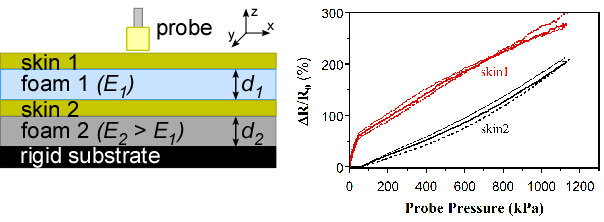
Tactile sensing is of interest for facilitating interactions between robots and humans. To aid the robot’s interpretation of human contact, the use of a multilayer cutaneous tactile sensing architecture that can provide more information and an expanded force sensing range was explored, revealing differences in the signal generated by a machine versus a human. The multi-layer system consisted of two stretchable sensing skins alternating with two foam layers of different stiffness. When human touch was compared with machine indentation, a large variability in human touch was found. Thus, although the topmost skin, placed over a soft foam, was able to better recognize light contacts, a second underlying skin, placed over a harder foam, was required to gauge stronger human contacts. Out-of-plane touch modalities, such as tapping and punching, could be identified using strip-shaped skins having just two electrodes. To provide distributed sensing, the technique of electrical impedance tomography was employed with the multi-layer architecture using larger-area skins having electrodes around the perimeter. Distributed touch modalities, such as multi-point finger presses and sliding, were distinguished from single-point pressing. The distributed multi-layer sensing system also had the ability to assess higher-force touches. |
2018 |
sens-cell |
 B. Senevirathna, S. Lu, M. Dandin, J. Basile, E. Smela, and P. Abshire B. Senevirathna, S. Lu, M. Dandin, J. Basile, E. Smela, and P. Abshire
IEEE Trans. Biomed. Circ. Syst. 12(3), 510-20, DOI: 10.1109/TBCAS.2018.2821060 (2018)
[Abstract]
direct link to PDF on IEEE site
We describe a capacitance sensor array that has been incorporated into a lab-on-CMOS system for applications in monitoring cell viability. This paper presents analytical models, calibration results, and measured experimental results of the biosensor. The sensor has been characterized and exhibits a sensitivity of 590 kHz/fF. We report results from benchtop tests and in vitro experiments demonstrating on-chip tracking of cell adhesion as well as monitoring of cell viability. Human ovarian cancer cells were cultured on chip, and measured capacitance responses were validated by comparison with images from photomicrographs of the chip surface. Analysis was performed to quantify cell proliferation and adhesion, and responses to live cells were estimated to be 100 aF/cell. |
2018 |
sens-piezo |
 Y. Chen, M. Yu, H. A. Bruck, and E. Smela Y. Chen, M. Yu, H. A. Bruck, and E. Smela
Smart Mater. Struct. 27:065005, DOI: 10.1088/1361-665X/aabc29 (2018)
[Abstract]
direct link to PDF on IOP site - email me for copy if no access through your institution
To allow robots to interact with humans via touch, new sensing concepts are needed that can detect a wide range of potential interactions and cover the body of a robot. In this paper, a skin-inspired multi-layer tactile sensing architecture is presented and characterized. The structure consists of stretchable piezoresistive strain-sensing layers over foam layers of different stiffness, allowing for both sufficient sensitivity and pressure range for human contacts. Strip-shaped sensors were used in this architecture to produce a deformation response proportional to pressure. The roles of the foam layers were elucidated by changing their stiffness and thickness, allowing the development of a geometric model to account for indenter interactions with the structure. The advantage of this architecture over other approaches is the ability to easily tune performance by adjusting the stiffness or thickness of the foams to tailor the response for different applications. Since viscoelastic materials were used, the temporal effects were also investigated. |
2017 |
sens-piezo |
 E. M. Barnett, J. J. Lofton, M. Yu, H. Bruck, and E. Smela E. M. Barnett, J. J. Lofton, M. Yu, H. Bruck, and E. Smela
Sci. Rep. 7:5118, DOI:10.1038/s41598-017-05341-w (2017)
[Abstract]
direct link to PDF direct link to supporting information
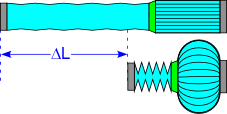
The field of soft robots would benefit from electrically controlled contractile actuators in the form of fibers that achieve a strain of 20% in less than a second while exerting high force. This work explores possible designs for achieving this goal using self-contained electroosmotic fluid pumping within a tube-shaped structure. The most promising configuration is a combination of a bellows and a McKibben-type muscle, since pumping fluid from the former to the latter results in contraction of both portions. Realizing such a device entails challenges in fabrication and electrokinetic fluid pumping in closed systems. Further studies of electroosmotic flow in salt-free organic solvents are needed. |
2017 |
act-nast |
 E. Smela E. Smela
Faraday Discuss. DOI: 10.1039/c6fd00235h (2017)
[Abstract]
link to PDF on RSC site direct link to supporting information
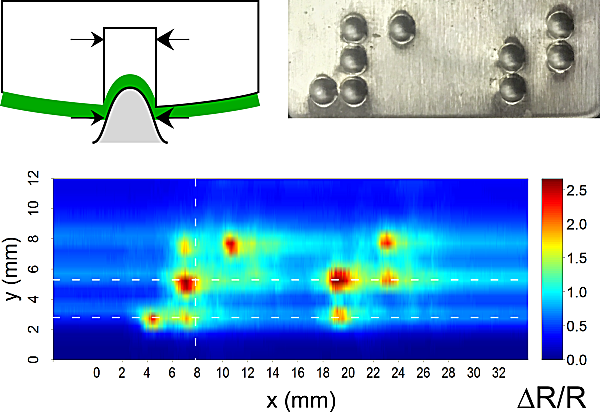
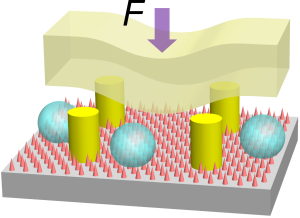
A tactile sensing architecture is presented for detection of surface features that have a particular target size, and the concept is demonstrated with a braille pattern. The approach is akin to an inverse of mechanical profilometry. The sensing structure is constructed by suspending a stretchable strain-sensing membrane over a cavity. The structure is moved over the surface, and a signal is generated through mechanical spatial filtering if a feature is small enough to penetrate into the cavity. This simple design is tailorable and can be realized by standard machining or 3D printing. Images of target features can be produced with even a low-cost compliant sensor. In this work a disposable elastomeric piezoresistive strain sensor was used over a cylindrical “finger” part with a groove having a width corresponding to the braille dot size. A model was developed to help understand the working principle and guide finger design, revealing amplification when the cavity matches the feature size. The new sensing concept has the advantages of being easily reconfigured for a variety of sensing problems and retrofitted to a wide range of robotic hands, as well as compatibility with many compliant sensor types. |
2016 |
act-nast |
 D. Sritharan and E. Smela D. Sritharan and E. Smela
Polymers 8(11) 400 (2016)
[Abstract]
link to PDF on MDPI site
direct link to supporting information
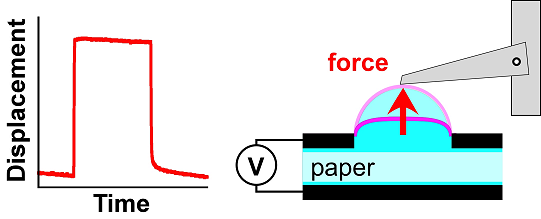
A voltage-controlled hydraulic actuator is presented that employs electroosmotic fluid flow (EOF) in paper microchannels within an elastomeric structure. The microfluidic device was fabricated using a new benchtop lamination process. Flexible embedded electrodes were formed from a conductive carbon-silicone composite. The pores in the layer of paper placed between the electrodes served as the microchannels for EOF, and the pumping fluid was propylene carbonate. A sealed fluid-filled chamber was formed by film-casting silicone to lay an actuating membrane over the pumping liquid. Hydraulic force generated by EOF caused the membrane to bulge by hundreds of micrometers within fractions of a second. Potential applications of these actuators include soft robots and biomedical devices. |
2016 |
sens-cell |
 T. Datta-Chaudhuri, E. Smela, and P. Abshire T. Datta-Chaudhuri, E. Smela, and P. Abshire
IEEE Trans. Biomed. Circ. Syst. 10(6)1129-1142 (2016)
[Abstract]
link to PDF on IEEE site
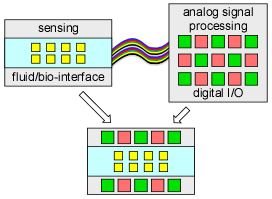
CMOS chips are increasingly used for direct sensing and interfacing with fluidic and biological systems. However, distinct and vexing technical challenges arise from the disparate requirements of biosensors and integrated circuits. The IC design process must take into account operation at 37 °C, electro-thermal effects and corresponding power limitations, additional floorplanning complexity, signal coupling through fluid, and electrochemical effects. System modeling has to address not only circuit design but also physical structures post-fabricated on the surface of the IC and the behavior of biological components. The next step is packaging, which must enable electrical operation while also allowing fluidic integration for cell culture; for MEMS processing it should ideally provide a flat surface. At the final stage, cell culture on an IC chip requires surface preparation and biocompatible materials. The opacity of the chip presents challenges in optical assessment, while incubator-free cell culture presents its own issues. We recommend a two-step modeling approach to overcome the lack of multi-domain modeling tools: using FEM simulation to determine electro-thermal and electrostatic effects, and using those results to modify simulation parameters for IC design. These simulations can also aid in material selection and in ascertaining layer thicknesses for packaging. |
2016 |
sens-cell |
 T. Datta-Chaudhuri, R. C. Araneda, P. Abshire, and E. Smela
Sens. Act. B 235 (1 Nov), 74–78 (2016)
[Abstract]
link to PDF on Science Direct site
direct link to supporting information
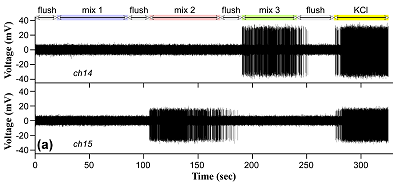
On-chip sensing of physical signals is now relatively straightforward, with on-chip tilt sensors and cell phone cameras now ubiquitous, but sensing of odorants has proven to be far more challenging. A general purpose, mobile electronic nose would address pressing needs in security and food safety. We demonstrate here an approach that combines living olfactory sensory neurons (OSNs) with integrated circuitry. The hybrid bio-electronic chip harnesses the as-yet unparalleled capabilities of olfactory sensory neurons – in variety, selectivity, and ability to function in the real world – and takes advantage of modern silicon chip technology for detecting and processing electrical signals. OSNs were cultured directly over an array of electrodes on the surface of a custom integrated circuit so that the signals, a series of “spikes” upon odorant binding, could be locally detected and processed. Consistent and selective responses to specific odorants were recorded from individual neurons. |
2016 |
sens-piezo |
 Y. Chen, M. Yu, H. A. Bruck, and E. Smela
Sens. Act. B 25, 055006 (2016)
[Abstract]
link to PDF on IOP site
direct link to supporting information
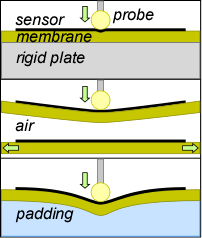
For robots that work collaboratively with people, often referred to as “co-robots”, it would be beneficial for them to be soft or padded and to have a touch-sensing “skin” to enable tactile environmental awareness. However, a sensing skin over a padding material that undergoes large deformations requires “stretchable” materials, which may possess time-dependent or viscoelastic mechanical responses. In this work the roles that a padding layer plays when placed under a stretchable sensing layer was investigated. A strain-sensing skin was formed by coating a thin film of compliant piezoresistive sensing paint, consisting of exfoliated graphite in latex, onto a rubber membrane, and the response of the skin was characterized. The change in resistance was linear with tensile strain. The role of the padding material was then investigated under indentation by examining three foams and two elastomers. As expected, the padding enhanced energy dissipation as shown by hysteresis in the sensor response, which is linked to its protective function; the hysteresis was comparable for the five padding materials. The padding also provided an unexpected advantage: it magnified the change in resistance compared to that obtained under free displacement in air. While hysteresis in viscoelastic materials can largely be handled with an appropriate model, inconsistency cannot be, and the two elastomers were found to have unacceptably high variability because of micro-cracks and other defects in these materials. On the other hand, foams that had few defects and regular cell sizes gave good consistency across trials and different sensor positions over the padding. Combined with their lighter weight and availability in a wide range of stiffness, we conclude that foams make a better choice for padding of co-robots. |
2015 |
act-nast |
 D. Sritharan, A. S. Chen, P. Aluthgama, B. Naved, and E. Smela
Electrophoresis 36, 2622-2629 (2015)
[Abstract]
link to PDF on Wiley site
direct link to supporting information
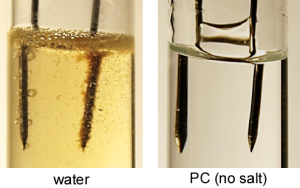
For electroosmotic pumping, a large direct-current electric field (10+ V/cm) is applied across a liquid, typically an aqueous electrolyte. At these high voltages, water undergoes electrolysis to form hydrogen and oxygen, generating bubbles that can block the electrodes, cause pressure fluctuations, and lead to pump failure. The requirement to manage these gases constrains system designs. This article presents an alternative polar liquid for directcurrent electrokinetic pumping, propylene carbonate (PC), which remains free of bubbles up to at least 10 kV/cm. This offers the opportunity to create electrokinetic devices in closed configurations, which we demonstrate with a fully sealed microfluidic hydraulic actuator. Furthermore, the electroosmotic velocity of PC is similar to that of water in PDMS microchannels. Thus, water could be substituted by PC in existing electroosmotic pumps. |
2015 |
sens-piezo |
 E. Sauerbrunn, Y. Chen, J. Didion, M. Yu, E. Smela, and H. A. Bruck E. Sauerbrunn, Y. Chen, J. Didion, M. Yu, E. Smela, and H. A. Bruck
Phys. Stat. Sol. 212 (10), 2239–2245 (2015)
[Abstract]
link to PDF on Wiley site
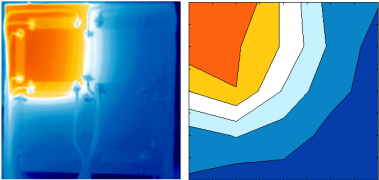
Sensing temperature distributions over an area is of interest for many applications, and it is currently performed using sensors that are attached to the structure. In this work a conductive “smart paint”, made fromlatex and exfoliated graphite, is introduced for temperature sensing. This provides, as an alternative to manual fixation, the ability to integrate sensors during fabrication because the approach is amenable to additive manufacturing technologies such as 3D printing. We demonstrate that calibration of the spray-coatable polymer/carbon composite thin film sensors allows accurate temperature measurement over an area. We further demonstrate continuous, distributed temperature sensing by employing electrical impedance tomography to reconstruct a thermal image from measurements at the perimeter of the sensing region. |
2015 |
other |
 I. D. Jung, M. C. Lee, H. Lim, E. Smela, and J. S. Ko
Appl. Surf. Sci., 349, 705–714 (2015)
[Abstract]
link to PDF on Elsevier site
direct link to supporting information
Because of their fragility, nanostructured surfaces have not been used in applications that requiremechanical contact with the environment. This paper demonstrates the utility of an array of“microbumpers” in the form of pillars rising above a nanostructured surface to provide protection. Super-hydrophobic surfaces with micro-pillar arrays of varying pitch were fabricated and subjected to repeatedvertical touch with a PDMS finger replica under different applied forces, such as would be experiencedby a touch screen display. For sufficiently small pitches, the microbumpers maintained the strong waterrepellency and low droplet adhesion, even after 1000 touch cycles, but if the pitch was too large thenanostructures were damaged and the superhydrophobicity lost. In comparison, surfaces comprisingonly nanostructures lost superhydrophobicity almost immediately. To image surface wetting by the waterdroplets, a droplet freeze-fixing, resin-embedding (FFRE) technique was developed. The approach of dec-orating a surface with microbumpers to provide mechanical protection should be applicable to a widerange of substrates with coatings optimized for various functions. |
2015 |
act |
 B. Balakrisnan, A. N. Nacev, and E. Smela
Smart Mater. Struct., 24(045032 (2015)
[Abstract]
link to PDF on IOP site
direct link to supporting information
direct link to Matlab program
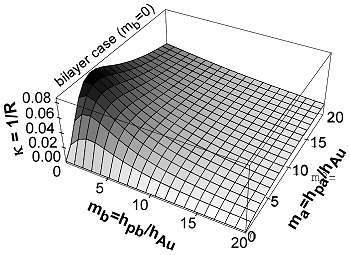
The effects of layer thickness and stiffness on multilayer bending actuator performance were
investigated with an analytical mechanical model. Performance was evaluated in terms of
curvature, blocked force, and work. Multilayer device designs corresponding to dielectric
elastomer actuator, ionic polymer metal composite, and conjugated polymer structures were
examined. Normalized plots of the performance metrics as functions of relative layer thickness
and stiffness are presented that should allow initial, starting-point estimates for designs for
particular applications. The results show that to achieve high curvature, layer thickness and
stiffness may need to be set above or below particular bounds, or varied together, depending on
the device configuration; often there is a broad plateau of combinations that work equally well.
There is a conflict between achieving high bending and high force: the former requires the device
to behave as much as possible like a simple bilayer with optimal ratios of thickness and modulus,
while the latter requires thicker layers and shows little dependence on their moduli. Finally, to
maximize work there are areas in the thickness-modulus plane that should be avoided, these
areas varying with the configuration in sometimes surprising ways. |
2014 |
fluid |
 J. M. Burke, R. E. Zubajlo, E. Smela, and I. M. White
Biomicrofluidics, 8(2), 024105 (2014)
[Abstract]
link to PDF on AIP site
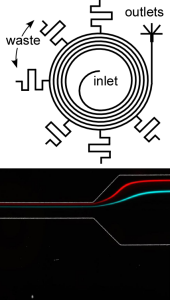
A spiral inertial filtration (SIFT) device that is capable of high-throughput (1 ml/min), high-purity particle separation while concentrating recovered target particles by more than an order of magnitude is reported. This device is able to remove large fractions of sample fluid from a microchannel without disruption of concentrated particle streams by taking advantage of particle focusing in inertial spiral microfluidics, which is achieved by balancing inertial lift forces and Dean drag forces. To enable the calculation of channel geometries in the SIFT microsystem for specific concentration factors, an equivalent circuit model was developed and experimentally validated. Large particle concentration factors were then achieved by maintaining either the average fluid velocity or the Dean number throughout the entire length of the channel during the incremental removal of sample fluid. The SIFT device was able to separate MCF7 cells spiked into whole blood from the non-target white blood cells (WBC) with a recovery of nearly 100% while removing 93% of the sample volume, which resulted in a concentration enhancement of the MCF7 cancer cells by a factor of 14. |
2014 |
PCR |
 M. Armani, M. Tangrea, B. Yang, A. Rosenberg, K. Ylaya, J. Martinez, J. Rodriguez-Canales, J. Hanson, B. Shapiro, M. R. Emmert-Buck, E. Smela, and S. M. Hewitt
Diag. Molec. Pathol., Published Ahead-of-Print doi: 10.1097/PDM.0000000000000039, (2014)
[Abstract]
link to AIMM site direct link to unformatted text and supporting information
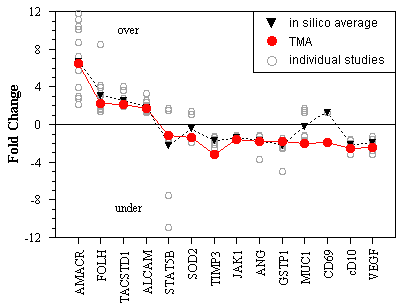
The development of prognostic and diagnostic biomarkers, such as those from gene expression studies, requires independent validation in clinical specimens. Immunohistochemical analysis on tissue microarrays (TMAs) of formalin-fixed paraffin-embedded tissue is often used to increase the statistical power, and it is used more often than in situ hybridization, which can be technically limiting. Herein, we introduce a method for performing quantitative gene expression analysis across a TMA using an adaptation of 2D-RT-qPCR, a recently developed technology for measuring transcript levels in a histologic section while maintaining 2-dimensional positional information of the tissue sample. As a demonstration of utility, a TMA with tumor and normal human prostate samples was used to validate expression profiles from previous array-based gene discovery studies of prostate cancer. The results show that 2D-RT-qPCR expands the utility of TMAs to include sensitive and accurate gene expression measurements.
|
2014 |
act-CP |
 E. D. Daneshvar and E. Smela E. D. Daneshvar and E. Smela
Adv. Healthcare Mater., 3(7), 1026–1035 (2014)
[Abstract]
link to PDF on Wiley site
direct link to unformatted text & supporting information
Conjugated polymer actuators have potential use in implantable neural interface devices for modulating the position of electrode sites within brain tissue or guiding insertion of neural probes along curved trajectories. The actuation of polypyrrole (PPy) doped with dodecylbenzenesulfonate (DBS) was characterized to ascertain whether it could be employed in the cerebral environment. Microfabricated bilayer beams were electrochemically cycled at either 22 or 37 °C in aqueous NaDBS or in artificial cerebrospinal fluid (aCSF). Nearly all the ions in aCSF were exchanged into the PPy - the cations Na+, K+, Mg2+, Ca2+, as well as the anion PO43-; Cl- was not present. Nevertheless, deflections in aCSF were comparable to those in NaDBS and they were monotonic with oxidation level: strain increased upon reduction, with no reversal of motion despite the mixture of ionic charges and valences being exchanged. Actuation depended on temperature. Upon warming, the cyclic voltammograms showed additional peaks and an increase of 70% in the consumed charge. Bending was, however, much less affected: strain increased somewhat (6-13%) but remained monotonic, and deflections shifted (up to 20%). These results show how the actuation environment must be taken into account, and demonstrate proof of concept for actuated implantable neural interfaces. |
2014 |
sens-cell |
 T. Datta-Chaudhuri, P. Abshire, and E. Smela T. Datta-Chaudhuri, P. Abshire, and E. Smela
Lab Chip, 14(10), 1753 - 1766 (2014)
[Abstract]
link to PDF on RSC site direct link to supporting information
Combining integrated circuitry with microfluidics enables lab-on-a-chip (LOC) devices to perform sensing, freeing them from benchtop equipment. However, this integration is challenging with small chips, as is briefly reviewed with reference to key metrics for package comparison. In this paper we present a simple packaging method for including mm-sized, foundry-fabricated dies containing complementary metal oxide semiconductor (CMOS) circuits within LOCs. The chip is embedded in an epoxy handle wafer to yield a level, large-area surface, allowing subsequent photolithographic post-processing and microfluidic integration. Electrical connection off-chip is provided by thin film metal traces passivated with Parylene-C. The Parylene is patterned to selectively expose the active sensing area of the chip, allowing direct interaction with a fluidic environment. The method accommodates any die size and automatically levels the die and handle wafer surfaces. Functionality was demonstrated by packaging two different types of CMOS sensor ICs, a bioamplifier chip with an array of surface electrodes connected to internal amplifiers for recording extracellular electrical signals and a capacitance sensor chip for monitoring cell adhesion and viability. Cells were cultured on the surface of both types of chips, and data were acquired using a PC. Long term culture (weeks) showed the packaging materials to be biocompatible. Package lifetime was demonstrated by exposure to fluids over a longer duration (months), and the package was robust enough to allow repeated sterilization and re-use. The ease of fabrication and good performance of this packaging method should allow wide adoption, thereby spurring advances in miniaturized sensing systems. |
2013 |
sens-piezo |
 J. Wissman, A. Perez-Rosado, A. Edgerton, B. M. Levi, Z. N. Karakas, M. Kujawski, A. Philipps, N. Papavizas, D. Fallon, H. A. Bruck, and E. Smela
Smart Mater. Struct., 22, 085031 (2013)
[Abstract]
link to PDF on IOP site
direct link to supporting information
Over the past several years there has been an increasing interest in
the development of miniature air vehicles (MAVs) with flapping wings. To allow these MAVs to adjust to changes
in wind direction and to maximize their efficiency, it is desirable to monitor the deformation of the wing
during flight. This paper presents a step in this direction, demonstrating the measurement of strain
on the surface of the wing using minimally invasive compliant piezoresistive sensors. The strain gauges
consisted of latex mixed with electrically conducting exfoliated graphite, and they were applied by
spray coating. To calibrate the gauges, both static and dynamic testing up to 10 Hz were performed using
cantilever structures. In tension the static sensitivity was a linear 0.4 Ohm/microstrain and the gauge
factor was 28; in compression, the gauge factor was -5. Although sensitivities in tension and compression
differed by a factor of almost six, this was not reflected in the dynamic data, which followed the strain
reversibly with little distortion. There was no attenuation with frequency, indicating a sufficiently small
time constant for this application. The gauges were thin, compliant, and light enough to measure, without
interference, deformations due to shape changes of the flexible wing associated with generating lift and
thrust. During flapping the resistance closely tracked the generated thrust, measured on a test stand, with
both signals tracing figure-8 loops as a function of wing position throughout each cycle. |
2012 |
stretch |
 B. Balakrisnan, A. Nacev, J. M. Burke, A. Dasgupta, and E. Smela B. Balakrisnan, A. Nacev, J. M. Burke, A. Dasgupta, and E. Smela
Smart Mater. Struct., 21, 075033 (2012)
[Abstract]
link to PDF on IOP site
direct link to supporting information
Meandering beams, crenellated surfaces, and zigzag-shaped electrodes are
employed as compliant elements in microscale applications ranging from springs attached to proof masses
in microelectromechanical systems (MEMS) to stretchable electrodes in flexible electronics
and dielectric elastomer actuators. An understanding of how the meander shape affects the
stiffness of these structures would permit preliminary design without the necessity of
fabricating or running simulations on each case. In this paper, we present general guidelines
for designing meandering cantilevers, showing how the amplitude, angle, length, and thickness
affect both the axial and bending stiffnesses. Simple analytical expressions are derived, and the
results are compared with those from numerical simulations and experimental measurements.
The more complex case of a stiff thin film overlying a crenellated elastomer is also simulated. |
2012 |
MEMS |
 M. Dandin, P. Abshire, and E. Smela
J. Micromech. Microeng., 22, 095018 (2012)
[Abstract]
link to PDF on IOP site direct link to supporting information
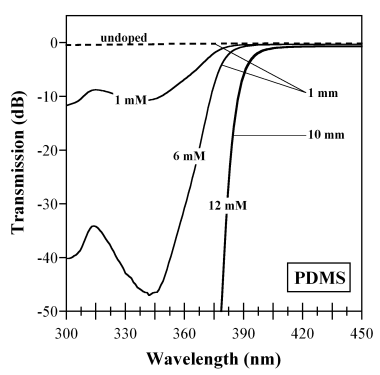
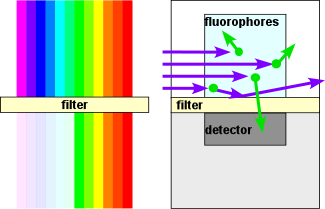
Optical filters for blocking ultraviolet (UV)
light were fabricated by doping various polymer
hosts with a UV absorbing chromophore. The polymers were polydimethylsiloxane (PDMS), a
silicone elastomer frequently used in microfluidics, SU-8, a photopatternable epoxy, and
Humiseal 1B66, an acrylic coating used for moisture protection of integrated circuits. The
chromophore was 2-(2�-hydroxy-5�-methylphenyl) benzotriazole (BTA), which has a high
extinction coefficient between 300 nm and 400 nm. We demonstrate filters 5 µm thick that
exhibit high ultraviolet rejection (nearly -40 dB at 342 nm) yet pass visible light (near
0 dB above 400 nm), making them ideal for ultraviolet-excited fluorescence sensing within
microsystems. The absorbance of the BTA depended on the host polymer. These filters are
promising for integrated fluorescence spectroscopy in bioanalytical platforms because they can
be patterned by dry etching, molding or exposure to ultraviolet light. |
2012 |
fluid |
 J. M. Burke and E. Smela
Biomicrofluidics, 6 (1), 016506 (2012)
[Abstract]
link to PDF on AIP site
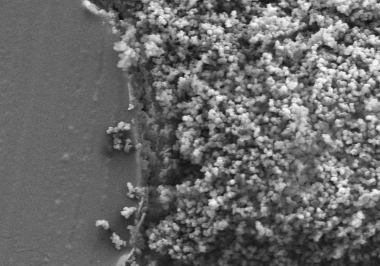
A new method of surface modification is described for enabling the in situ
formation of homogenous porous polymer monoliths (PPMs) within poly(dimethylsiloxane) (PDMS) microfluidic channels
that uses 365 nm UV illumination for polymerization. Porous polymer monolith formation in PDMS can be challenging
because PDMS readily absorbs the monomers and solvents, changing the final monolith morphology, and because PDMS
absorbs oxygen, which inhibits free-radical polymerization. The new approach is based on sequentially absorbing a
non-hydrogen-abstracting photoinitiator and the monomers methyl methacrylate and ethylene diacrylate within the
walls of the microchannel, and then polymerizing the surface treatment polymer within the PDMS, entangled with it
but not covalently bound. Four different monolith compositions were tested, all of which yielded monoliths that
were securely anchored and could withstand pressures exceeding the bonding strength of PDMS (40 psi) without
dislodging. One was a recipe that was optimized to give a larger average pore size, required for low back pressure.
This monolith was used to concentrate and subsequently mechanical lyse B lymphocytes. |
2011 |
PCR |
 M. Armani, M. A. Tangrea, B. Shapiro, M. R. Emmert-Buck, and E. Smela
Anal. Bioanal. Chem., 400 (10), 3383-3393 (2011)
[Abstract]
link to PDF on Springer site
direct link to supporting information
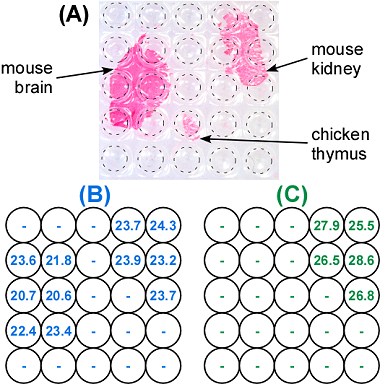
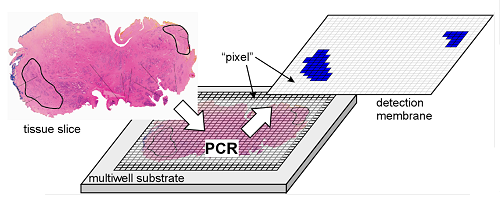
Measurement of mRNA levels across tissue samples facilitates an
understanding of how genes function and what their roles are in disease. Quantifying low-abundance
mRNA requires a workflow that preserves spatial information, isolates RNA, and performs RT-qPCR.
This is complex because these steps are typically performed in three separate platforms. In the
present study, we describe 2D-RT-qPCR, a method that quantifies RNA across tissues sections in a
single integrated platform. The method uses the grid format of a multi-well plate to macrodissect
tissue sections and preserve the spatial location of the RNA; this also eliminates the need for physical
homogenization of the tissue. A new lysis and nucleic acid purification protocol is performed in the same
multi-well plate, followed by RT-qPCR. The feasibility 2D-RT-qPCR was demonstrated on a variety of tissue
types. Potential applications of the technology as a high-throughput tissue analysis platform are discussed. |
2011 |
act-CP |
 S. Alben, B. Balakrisnan, and E. Smela
Nano Lett., 11 (6), 2280–2285 (2011)
[Abstract]
link to PDF on ACS site
direct link to supporting information
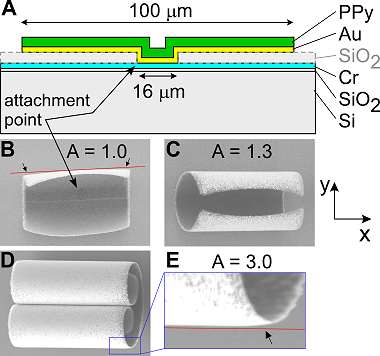
We elucidate the reason for preferential bending
along the long edge in thin rectangular bilayers in which one of
the layers is isotropically strained. While this preference has
been observed previously, the physical basis for this preference
has not been understood. We find that the bending direction is
determined by the existence of doubly curved regions at the
curled edges, which lower the energy. This energy difference
between "spiral" and "cigar" shapes increases with aspect ratio. |
2010 |
stretch |
 M. Kujawski, J. D. Pearse, and E. Smela
Carbon, 48 (9), 2409-2417 (2010)
[Abstract]
link to PDF on ScienceDirect site
direct link to supporting information
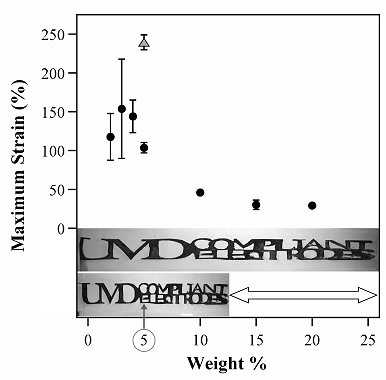
A compliant electrode material has been realized by blending an insulating
polydimethylsiloxane (PDMS) elastomer with a conductive exfoliated graphite filler, which was produced by microwave
irradiation. The conductivity and stiffness of the electrodes were determined as a function of filler concentration.
These materials exhibited a low percolation threshold: above 3 wt% loading they became conductive, with conductivities
reaching as high as 0.4 S/cm. They remained elastomeric upon loading up to 25 wt%, having a Young's modulus of only 1.4 MPa.
This modulus (corresponding to a 220% increase compared to the unloaded PDMS) is the lowest reported for loaded elastomers
above the percolation threshold. Scanning electron microscopy showed that the composites contained small voids, unlike
unloaded PDMS, which might be responsible for the low modulus. The performance of these electrodes is comparable to that of PDMS
loaded with carbon nanotubes, but the exfoliated graphite material can be produced at a fraction of the cost. |
2009 |
PCR |
 M. Armani, J. Rodriguez-Canales, J. Gillespie, M. Tangrea, H. Erickson, M. R. Emmert-Buck, B. Shapiro, and E. Smela
Lab Chip, 9(24), 3526 - 3534 (2009)
[Abstract]
link to PDF on RSC site direct link to supporting information
A novel approach was developed for mapping the location of target DNA sequences in tissue
sections. The method combines a high-density, multi-well plate with an innovative single-tube procedure to directly extract,
amplify, and detect the DNA in parallel while maintaining the two-dimensional (2D) architecture of the tissue. A 2D map of the
gene glyceraldehyde 3-phosphate dehydrogenase (GAPDH) was created from a tissue section and shown to correlate with the spatial
area of the sample. It is anticipated that this approach may be easily adapted to assess the status of multiple genes within
tissue sections, yielding a molecular map that directly correlates with the histology of the sample. This will provide
investigators with a new tool to interrogate the molecular heterogeneity of tissue specimens. |
2009 |
act-nast |
 M. E. Piyasena, R. Newby, T. J. Miller, B. Shapiro, and E. Smela
Sens. Act. B., 141, 263-269 (2009)
[Abstract]
link to PDF on ScienceDirect site
direct link to supporting information
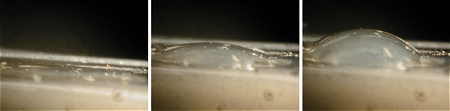
A prototype electroactive polymer actuator has been developed based on
electroosmotic (EO) pumping to create hydraulic pressure. The actuator was fabricated from poly(dimethylsiloxane)
(PDMS) with embedded micro-scale channels, reservoirs, and electrodes surmounted by a membrane. An applied voltage
caused one reservoir to expand as fluid was pumped into it, and the other reservoir to contract, with the membrane
above the expansion reservoir rising by 400 mm within a few seconds. Since the prototype was made from PDMS, which
is an elastomer, the device was entirely flexible. The actuator performance was characterized, and it agreed well
with predicted values. Furthermore, the calculations indicate that, once optimized, such actuators could have high
stress as well as high strain and high speed. By combining unit cells such as these into a material and actuating them
individually via independently-controlled flexible electrodes, one could realize smart materials that could change shape.
Other future applications may include micro-valves, micro-positioners, soft robots, and active camouflage layers. |
2009 |
MEMS |
 B. Balakrisnan, S. Patil, and E. Smela
J. Micromech. Microeng., 19, 047002 (2009)
[Abstract]
link to PDF on IOP site
PDMS films 10 microns thick can be patterned within 30 minutes by combining dry etching to
achieve substantially vertical sidewalls with wet etching to achieve high etch rates and to protect the underlying substrate from
attack. Dry etching alone would have taken 5 hours, and wet etching alone would produce severe undercutting. In addition, using
either technique alone produces undesirable surface morphologies. The mask used during etching is critical to a successful patterning
outcome. E-beam evaporated Al was found to work well, adhering strongly to oxygen plasma treated PDMS, and holding up well during both
dry and wet etching. To prevent wrinkling of the PDMS, a fast deposition rate should be used.
|
2009 |
CP |
 X. Wang and E. Smela
J. Phys. Chem. C , 113 (1), 359-368 (2009)
[Abstract]
link to PDF on ACS site link to supporting information, including videos
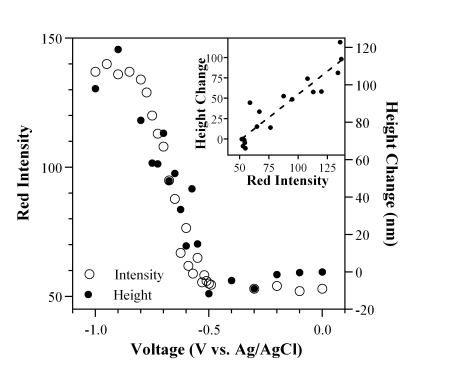
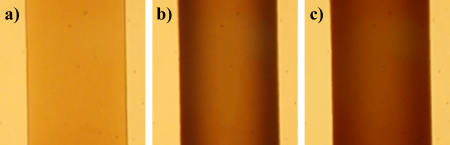
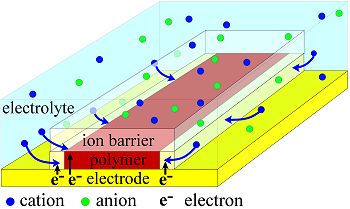
The optical-mechanical-electrochemical coupling in polypyrrole films doped with
dodecylbenzenesulfonate, PPy(DBS), is studied during electrochemical switching. A special experimental geometry is
used in which the top surface of the film is covered by a transparent ion barrier that constrains charge-compensating
cations to enter and exit the film only at the edges. The cation concentration determines the volume of the polymer,
and is directly related to the oxidation level of the polymer, which determines its color. During electrochemical reduction,
the edges of the film lighten as the cations arrive, and this light color travels as a front to the center of the film. At
the same time, the height of the film increases when and where the color lightens, and the increase in height is directly
proportional to the change in color intensity. The height and the intensity attain their maximum values as the front passes
and do not increase further thereafter, indicating that the ion concentration in the fully reduced state has a maximum value
that is not exceeded. The color and volume changes are associated with only the first pair of peaks in the cyclic voltammogram,
which represent only a fraction of the consumed charge in a typical electrochemical scan.
|
2009 |
CP |
 X. Wang and E. Smela
J. Phys. Chem. C , 113 (1), 369–381 (2009)
[Abstract]
link to PDF on ACS site link to supporting information, including videos
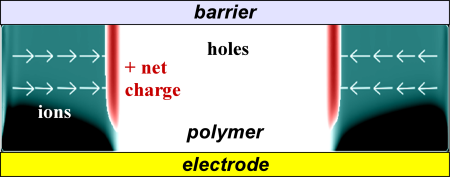
Lateral ion transport in conjugated polymer films is studied using a special experimental
geometry in which the top surface of the film is covered by a transparent ion barrier. Because of the barrier, when the
oxidation level of the polymer is switched electrochemically, charge-compensating ions can only enter and leave the polymer
from the edges. Since conjugated polymers are electrochromic, the color of the film changes during switching, and this can be
monitored to provide information on the oxidation level of different parts of the film. Since the oxidation level cannot change
until the cations arrive, the color also directly maps the positions of the cations. This geometry was employed to study cation
transport in polypyrrole doped with dodecylbenzenesulfonate, PPy(DBS). Upon reduction, the ions travel in a front from the edges
to the center of the film. During the first-ever reduction, this cation front stays sharp, but in subsequent reduction scans the
front moves 20-30 times faster and broadens as it moves. The higher the applied voltage, the faster the front moves, with a linear
dependence. The velocity of the front also strongly depends on the initial oxidation level of the polymer. During oxidation, on
the other hand, the entire film gradually darkens, with no front and no dependence of the switching speed on the applied potential.
|
2009 |
CP |
 X. Wang, B. Shapiro, and E. Smela
J. Phys. Chem. C , 113 (1), 382-401 (2009)
[Abstract]
link to PDF on ACS site link to supporting information
A finite element model for charge transport in conjugated polymers is developed based on
transport equations for ionic and electronic charge coupled with the Poisson equation. The model behavior is fully explored, and
its complexity is gradually increased to realize a full model that treats non-Fickian diffusion through non-constant coefficients
and that includes ion transport in the electrolyte. The simulation results are compared qualitatively with the experimental
results for the ion-barrier-covered PPy(DBS) film of Part 2 during electrochemical reduction, and the model is found to
successfully account for the dominant behaviors, including the emergence of a front. One of the key findings of the simulations
is that migration must be taken into account to correctly describe ion ingress: none of the various simulations in which ion
transport was only by diffusion predicted the experimental results. Another is that the front velocity is proportional to the
applied voltage, as found experimentally, and that the cation front can move into the polymer with a velocity v ~ sqrt(t) even
when the ions move by migration alone.
|
2009 |
CP |
 B. J. West, T. F. Otero, B. Shapiro, and E. Smela
J. Phys. Chem. B, 113 (5), 1277–1293 (2009)
[Abstract]
link to PDF on ACS site link to supporting information
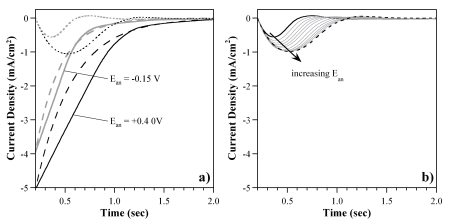
In conjugated polymer devices that switch from one oxidation level to another, such as
artificial muscles, it is important to understand memory effects that stem from conformational relaxation movements of the
polymer chains. Chronoamperometry during electrochemical switching of polypyrrole doped with dodecylbenzenesulfonate, PPy(DBS),
is used to gain insight into the conformational relaxation processes in cation-transporting materials. During oxidation, the
current decays exponentially with a time constant that decreases with the anodic voltage. During reduction, there is again an
exponentially decaying current with a time constant that decreases with the cathodic voltage, but superimposed on that is a
small current peak that increases in size with the voltage. This peak accounts for a maximum of 20% of the total reduction charge,
which is approximately the same amount of charge that is in the most cathodic pair of peaks in the cyclic voltammogram. The
position of this peak depends logarithmically on the applied cathodic potential (shifting to shorter times with larger Eca) as
well as on the anodic potential that was applied just prior to the reduction step (shifting to longer times with Ean).
Furthermore, the shoulder position depends logarithmically on the time that the prior anodic voltage was held (shifting to
longer times with twait). These results are consistent with the electrochemically stimulated conformational relaxation (ESCR) model.
|
2008 |
act-CP |
 E. Smela
MRS Bull., 33 (3), 197-204 (2008)
[Abstract]
only available for a fee from MRS -- email me for a PDF copy
Conjugated polymer artificial muscles fill a unique niche in the EAP portfolio.
They combine high strength, low voltage, and reasonable speed with versatile fabrication and design. This article
reviews the actuation mechanism in these materials and presents some of the designs that have been developed for
applications such as Braille displays, catheters, and bioMEMS devices.
|
2008 |
act-CP |
 S. B. Prakash, M. Urdaneta, M. Christophersen, E. Smela, and P. Abshire
Sens. Act. B , 129 (2), 699-704 (2008)
[Abstract]
link to PDF on ScienceDirect/Elsevier site
The paper reports, for the first time, an integrated potentiostat for driving electrochemical
actuation reactions on a CMOS chip. The integrated microsystem comprised on-chip working, counter, and pseudo-reference electrodes
fabricated on top of the necessary control circuitry. To demonstrate its capability, the potentiostat chip was used to
electrodeposit films of polypyrrole/dodecylbenzenesulfonate, PPy(DBS), in situ onto the working electrodes. It was also used
to cycle PPy(DBS) films between the fully oxidized and fully reduced states. This was confirmed by video recordings of the
distinctive electrochromic changes, as well as by the shapes of the cyclic voltammograms. Both showed good repeatability.
The demonstrated approach of integrating driver circuitry along with actuation electrodes on a common CMOS substrate eliminates
the need for an external potentiostat instrument, and can be widely employed for the fabrication and control of electrochemical
microactuators in integrated lab-on-a-chip systems.
|
2008 |
DEP |
 M. Urdaneta and E. Smela
Lab Chip, 8 (4), 550-556 (2008)
[Abstract]
link to PDF on RSC site
This paper presents a method to load cells into microvials using dielectrophoresis.
This has not been possible until now because such features produce electric field distortions that interfere with the
dielectrophoretic manipulation. Multiple frequency dielectrophoresis was used to actively cancel out the effect of these
distortions, allowing many cells to be loaded into a vial in a matter of seconds in fluid flows of up to 300 mm/s. Actively
cancelling field distortions enables the presence of features that would otherwise be prohibited near regions of dielectrophoretic
manipulation, significantly expanding the environments in which dielectrophoresis can be used.
|
2008 |
DEP |
 M. Urdaneta and E. Smela
J. Micromech. Microeng., 18 (1), Article Number: 015001(2008)
[Abstract]
link to PDF on IOP siteDielectrophoretic (DEP) forces produced by a pair of electrodes are used for such
applications as particle sorting in microfluidic systems. In order to allow quantitative comparison of different DEP systems,
we introduce a new figure of merit: dimensionless characteristic velocity corresponding to the maximum flow that can be used
while still successfully deflecting the desired particles. This avoids the necessity of performing numerical simulations in
order to compare designs and allows one to focus on general system design questions. The maximum deflection velocity is evaluated
versus a characteristic length for four different sorter configurations, yielding curves that can be used as tools to design DEP
sorters. Maximum flow predictions are compared with previously published theoretical and experimental results.
|
2007 |
DEP |
 M. Urdaneta and E. Smela
Electrophoresis, 28 (18), 3145-3155 (2007)
[Abstract]
link to PDF on Wiley/InterScience site
A novel method of modeling multiple frequency dielectrophoresis (MFDEP) is introduced
based on the concept of an effective Clausius-Mossotti factor, CMeff, for a particle that is exposed to electrical fields of
different frequencies, coming either from one or multiple pairs of electrodes. This analysis clearly illustrates how adding
frequencies adds control parameters, up to two additional parameters per frequency. As a result, MFDEP can be used for a
wide variety of applications, including separating particles with very similar Clausius-Mossotti spectra, trapping multiple
groups of cells simultaneously, and cancelling unwanted dielectrophoretic traps. Illustrating the modeling approach, we
determine the CMeffs for live and dead yeast cells, and then predict their equilibrium distribution on a 3-electrode configuration,
with two electrodes at different frequencies and the third electrode at ground. This prediction is validated experimentally,
using MFDEP to selectively attract live cells to one location and dead cells to another, trapping both. These results demonstrate
that the use of multiple frequencies for the manipulation of particles can enhance the performance of dielectrophoretic devices,
not only for sorting, but also for such applications as patterning cells in close proximity for the formation of cell consort |
2007 |
sens |
 M. Dandin, P. Abshire, and E. Smela
Lab Chip, 7 (8), 955-977 (2007)
[Abstract]
link to PDF on RSC site Numerous approaches have been taken to miniaturizing fluorescence sensing, which is a
key capability for micro-total-analysis systems. This critical, comprehensive review focuses on the optical hardware required
to attenuate excitation light while transmitting fluorescence. It summarizes, evaluates, and compares the various technologies,
including filtering approaches such as interference filters and absorption filters and filterless approaches such as multicolor
sensors and light-guiding elements. It presents the physical principles behind the different architectures, the state-of-the-art
micro-fluorometers and how they were microfabricated, and their performance metrics. Promising technologies that have not yet
been integrated are also described. This information will permit the identification of methods that meet particular design
requirements, from both performance and integration perspectives, and the recognition of the remaining technological challenges.
Finally, a set of performance metrics are proposed for evaluating and reporting spectral discrimination characteristics of
integrated devices in order to promote side-by-side comparisons among diverse technologies and, ultimately, to facilitate
optimized designs of micro-fluorometers for specific applications
|
2007 |
stretch |
 M. Urdaneta, R. Delille, and E. Smela
Adv. Mater., 19 (18), 2629-2633 (2007)
[Abstract]
link to PDF on Wiley/InterScience site
This communication presents a method for making compliant electrodes that have a maximum
conductivity of ~50 S/cm (corresponding to a sheet resistance of 2 Ohm/square) when unstretched and that do not lose conductivity
until elongated by over 100%. The electrodes have a Young's modulus under 10 MPa, and they show no sign of electrical or
mechanical fatigue even after thousands of strain cycles. Upon mechanical relaxation after strain cycling, their conductivity
and length recover nearly to their initial values, signifying a low electrical and mechanical hysteresis. The electrodes are
photopatternable, making them compatible with microfabrication technology. This enables the fabrication of meso- to micro-scale
electrodes for stretchable circuits, retinal implants, or high-deformation microelectromechanical systems (MEMS). |
2007 |
act-CP |
 Y. Liu, Q. Gan, S. Baig, and E. Smela
J. Phys. Chem. C, 111 (30), 11329-11338 (2007)
[Abstract]
link to PDF on ACS site Conjugated polymers have found applications as “artificial muscles” because
they undergo significant volume change upon electrochemical cycling. However, this large repeated
strain also leads them to delaminate from the underlying electrode. Two methods of improving
the adhesion of polypyrrole films to Au electrodes during extended electrochemical cycling were
quantitatively characterized. Both involved roughening the Au surface, the first by
electroplating and the second by etching. The extent of delamination was quantified using a
tape test at regular intervals during switching between the fully oxidized and reduced states
in an aqueous electrolyte, and the surfaces were characterized by scanning electron microscopy.
Untreated smooth control surfaces were simultaneously monitored the same way. Without surface
treatment, 3000 Å thick polypyrrole films doped with dodecylbenzenesulfonate, PPy(DBS),
delaminated unpredictably between 1 cycle and 20 000 cycles, with almost half the samples
failing before 3000 cycles. Electroplating even a thin layer of 1000 Å of Au in a
low-concentration plating bath consistently improved lifetimes to at least 10 000 cycles.
Thicker plating produced even better adhesion, and a 1 ím thick layer of electroplated
Au virtually eliminated delamination, extending the lifetime beyond 60 000 cycles. However, this
Au roughness is thicker than the PPy film itself, and is not useful for microactuator work.
Etching also improved adhesion, with the best results obtained for the shortest etch times. With
a roughness of only 700 Å, an undercut surface morphology was produced that allowed good
mechanical interlocking of the PPy. This process is appropriate for use with thin films; however,
it will be sensitive to the grain structure of the original Au film. On surfaces with no
delamination, it was possible to measure the oxidative degradation of the PPy(DBS) in the aqueous
electrolyte. The electroactivity decreased steadily over time, with 20% loss after 10 000 cycles,
50% at 35 000, and virtually no electroactivity by 60 000 cycles. |
2007 |
stretch |
 R. Delille, M. Urdaneta, K. Hsieh, and E. Smela
Smart Mater. Struct., 16 (2), S272 -279 (2007)
[Abstract]
link to PDF on IOP site
An elastomeric but electrically conducting material is presented that is fabricated
using a method inspired by ionic polymer-metal composites. The Young's modulus is only 10 MPa, and yet the conductivity is
nearly 1 S/cm and the material remains electrically conductive under uniaxial strains of 30%. Furthermore, this electrode
material is photo-patternable. Fabrication begins with mixing the platinum salt tetraammineplatinum(II) chloride into a
UV-curable acrylated urethane elastomer precursor (Loctite 3108). The mixture is crosslinked under UV light in less than a
minute and can therefore be patterned if it is exposed through a mask. The salt is then chemically reduced with sodium
borohydride, which results in the formation of 100 nm sized platinum nodules on the surface of the film. |
2006 |
act |
 B. Shapiro and E. Smela B. Shapiro and E. Smela
J. Intell. Mater. Syst. Struct., 18 (2), 181-186 (2006)
[Abstract]
link to PDF on Sage site
Stress at the interface of a bilayer actuator can lead to delamination, and this
stress increases with the difference in the Young’s moduli of the two layers. In this study, an actuator that
includes a third ‘buffer’ layer is modeled, and it is shown how optimization of the thickness and modulus of
this layer can reduce stress at that interface to zero, with no loss of curvature and only a small loss in force. A
polypyrrole (PPy)/conducting polymer/gold trilayer is used as a model system, with the aim of reducing stress at the weak
polymer/gold interface. For a 450nm thick PPy layer with a Young’s modulus of 0.2 GPa, an intermediate layer of 150nm
thickness with a modulus of 5 GPa reduces the stress to zero with no loss of curvature and only a 7% loss in force compared to
the bilayer case. |
2006 |
FO |
 P.-S. Jian and E. Smela
Smart Mater. Struct., 15, 821-828 (2006)
[Abstract]
link to PDF on IOP site
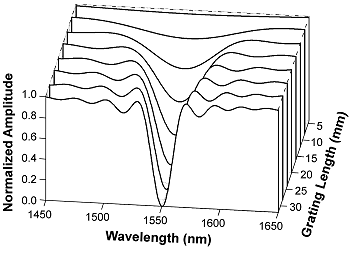
A long-period Bragg grating (LPG) is a resonant structure that couples light between
the fundamental core mode and specific cladding modes. The propagation constant of the cladding mode is sensitive to the
index of refraction outside the fiber, making LPGs applicable as sensors. The particular cladding mode orders that are
coupled depend on the grating period, the cladding radius, and the size of the refractive index modulation. However,
design of LPG sensors is largely empirical, making the realization of target characteristics difficult. A mathematical
model has been developed to understand how to control the mode coupling, which gives rise to a resonant attenuation peak
in the transmission spectrum. We show that the depth of the peak is governed by the length of the grating and by the
coupling constants between the core and cladding modes. Good agreement with experimental spectra suggests that the model
can be used as a practical tool to design long-period fiber grating sensors. The LPG is most sensitive when the ambient
index is close to, but less than, the index of the core. We also propose a Mach–Zehnder interferometry technique to
enhance sensitivity with not just a shift in the resonant peak, but also an amplitude modulation. |
2006 |
MEMS |
 R. Delille, M. Urdaneta, S. Moseley, and E. Smela
J. Microelectromech. Syst., 15 (5), 1108-1120 (2006)
[Abstract]
link to PDF on IEEE site direct link to supporting information Loctite photopatternable adhesives 3108, 3340, and 3525 are introduced for MEMS
applications. These materials are patterned within minutes by exposure to UV light followed by rinsing with a solvent;
no further processing is required. Because the uncured fluid is relatively insensitive to room light, this can be done
on any lab bench without the requirement for a clean room. The materials can be spin-coated to obtain films, or cast
between spacers for layers up to 1 cm thick, and the cured polymers range from elastomeric to rigid. These adhesives
are of interest for rapid, inexpensive fabrication of relatively low-resolution features (tens to hundreds of m) by
photo-curing. They can alternatively be molded, like PDMS, to achieve high resolution, as well as irreversibly bonded
after an O2 plasma treatment. In addition, like SU8 they can be used as molds for patterning PDMS. Initial characterization
of resolution, swelling, and biocompatibility were performed. One of the polymers, 3340, can be used for packaging bioMEMS-
on-CMOS chips, exploiting its biocompatibility and its photo-patternability at thicknesses of 1500 m to cover the bond wires
while exposing the chip surface. As further demonstrations of the versatility of these materials, multi-level, interconnected
channel structures were fabricated with a gelatin sacrificial layer, and magnetic films were prepared, since the polymers remain
patternable even with additives. |
2006 |
act-CP |
 M. Christophersen, B. Shapiro, and E. Smela
Sens. Act. B, 115, 596-609 (2006)
[Abstract]
link to PDF on ScienceDirect/Elsevier site direct link to supporting information Bilayer actuators of gold and polypyrrole doped with dodecylbenzenesulfonate, PPy(DBS),
were microfabricated with lengths and thicknesses that varied over two orders of magnitude. The actuators were connected to
rigid plates. The curvature of the bilayers was examined as a function of PPy and Au layer thicknesses to enable a determination
of the actuation strain and Young’s modulus of the PPy(DBS). Four different Au thicknesses were tested, and maximum
curvature was obtained in all cases at a PPy:Au thickness ratio of 5:1. The data could not be fit with a constant value for the
actuation strain; in addition, the PPy film bent even in the absence of an Au layer. Therefore, a model was developed that
included strain and modulus variations along the direction of film thickness. The experimental data were fit with an exponential
variation in actuation strain, starting at 20% at the surface of the PPy and decreasing to 3% at the gold interface in thicker
films. The Young’s modulus was found to be constant between 0.08 and 0.20 GPa in the oxidized state. These values differ
significantly from thick-film values. With this information, micro-actuators can now be designed to achieve a specified radius of
curvature. |
2005 |
act-CP |
 E. Smela and B. R. Mattes
Synth. Met., 151, 43-48 (2005)
[Abstract]
link to PDF on Elsevier/Science Direct site
Actuation of polyaniline (PANI)/Au bending bilayers and stretched polyaniline fibers doped
with 2-acrylamido-2-methyl-propane-1-sulfonic acid was studied in aqueous methanesulfonic acid. Electrochemical activity was
retained even upon repeated cycling into the pernigraniline state, unlike in HCl. The polyaniline expanded 1.6% from the
leucoemeraldine state to the emeraldine state, similar to the strain in HCl, and then contracted 0.2% upon entering the
pernigraniline state. The polyaniline was not mechanically stable in the pernigraniline state, however: the ultimate tensile
strength decreased so much that the actuators were rendered ineffective for lifting a load. In addition, in this electrolyte
the creep was considerable even under small loads; the Young’s modulus was only 0.4 GPa in the oxidized state, compared to
1.7 GPa in HCl.
Top of Page |
2005 |
act-CP |
 E. Smela, W. Lu, and B. R. Mattes
Synth. Met., 151 (1), 25–42 (2005)
[Abstract]
link to PDF on Elsevier/Science Direct site
Drawn polyaniline films and fibers doped with 2-acrylamido-2-methyl-propane-1-sulfonic acid,
PANI(AMPS), were electrochemically cycled in HCl and their material properties and actuation performance comprehensively
characterized. The Young's modulus was obtained as a function of applied voltage. Actuator figures of merit were derived
from isotonic and isometric measurements, including strain, stress, work, power, creep, and efficiency. The effects of sample
length, solution pH, electrochemical driving method, frequency, and load were studied, as well as the response of current to
applied load for sensing applications. This work presents a complete picture of a polyaniline actuator for the first time.
The behavior of the actuator is discussed in terms of the changes in the oxidation and protonation states of polyaniline. |
2005 |
act-CP |
 S. Maw, E. Smela, K. Yoshida, and R. B. Stein
Synth. Met., 155 (1), 18-26 (2005)
[Abstract]
link to PDF on ScienceDirect/Elsevier site direct link to supporting information Bilayers of gold-coated Kapton and polypyrrole doped with dodecylbenzenesulfonate
PPy(DBS), were prepared electrochemically, and their bending movement was studied under electrochemical stimulation.
The effects on actuation of monomer and electrolyte concentration during deposition, as well as electrolyte concentration
during subsequent electrochemical cycling, are presented. Lowering the pyrrole concentration decreased hysteresis, somewhat
increased actuator speed, and unexpectedly eliminated the so-called capacitive current above the oxidation peak. Neither
pyrrole nor electrolyte concentration in the deposition solution affected the extent of movement, despite the fact that the
former strongly impacted the cyclic voltammograms. The cyclic voltammograms were, therefore, not predictive of the extent of
bending, and strain could not be significantly improved by altering the concentration of either monomer or salt in the
deposition solution. Raising the deposition electrolyte concentration, and in particular raising it with respect to the
pyrrole concentration, did increase the movement to charge ratio, making the actuators more efficient. |
2005 |
act-CP |
 X. Lin, J. Li, E. Smela, and S. Yip
Int. J. Quant. Chem., 102, 980-985 (2005)
[Abstract]
only available for a fee from Wiley/InterScience -- email me for a PDF copy
Ab initio calculations show that a neutral polypyrrole chain in the ground state
assumes a helical shape resulting from a novel bending mechanism, while upon oxidation the chain becomes planar within the
polarons, an effect due to enhanced inter-ring pi bonding. This polaron-induced conformation change leads to an intrinsic
potential for inducing macroscopic strains in the single chain, with implications for further theoretical studies and experiments. |
2004 |
CP |
 X. Wang, B. Shapiro, and E. Smela
Adv. Mater., 16 (18), 1605-1609 (2004)
[Abstract]
link to PDF on Wiley/InterScience site
We report a new technique to study ion transport in materials that are electrochromic,
such as PPy(DBS). An experiment is introduced that makes electron transport fast compared with ion transport and that allows
the visualization of the ion locations in the film. A first-cut model is introduced which includes ion drift and diffusion,
and which accounts for much of the observed inplane ion transport behavior. |
2004 |
act-CP |
 W. Lu, E. Smela, P. Adams, G. Zuccarello, and B. R. Mattes
Chem. Mater., 16 (9), 1615-1621 (2004)
[Abstract]
link to PDF on ACS site
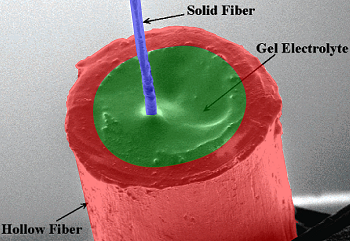
In this paper, we report the use of highly electrically conductive (400-1000 S/cm)
polyaniline fibers for the development of electrochemical linear actuators. The high conductivity of the fibers ensures
well-defined electroactivity and actuation without a metal backing. In propylene carbonate (PC), the electrochemical and
actuation behavior of the fibers was influenced by the dopants’ solubility and size: solubility in the electrolyte
ensured easy expulsion from the polymer, thus facilitating ion transport and resulting in high electroactivity and strain
in the fibers. Actuation of fibers was also affected by electrolyte anions. Small anions led to anion-exchange dominated
actuation, and large anions led to cationexchange dominated actuation. Electrochemical linear actuators with a unique
solid-in-hollow configuration were developed using a polyaniline solid fiber in a polyaniline hollow fiber with a gel
electrolyte. These actuators were simple to construct and allowed two-electrode operation. Isotonic strains of 0.9% and
isometric stresses of 0.9 MPa were realized. |
2003 |
act-CP |
 E. Smela
Adv. Mater., 15 (6), 481-494 (2003)
[Abstract]
link to PDF on Wiley/InterScience site
Conjugated polymers are electroactive, and they have found applications as artificial
muscles. Actuators that have been developed over the last decade have now reached the early stages of commercialization,
particularly for use in biomedical devices. This article reviews the motivation for using this class of actuator, the types
of devices that have been fabricated, and some of the biomedical applications that are being developed. Recommendations are
presented for future work on understanding the actuation mechanisms, on actuator design, and on the measurement of metrics.
Top of Page |
2003 |
act-CP |
 M. Pyo, C. C. Bohn, E. Smela, J. R. Reynolds, and A. B. Brennan
Chem. Mater., 15 (4), 916-922 (2003)
[Abstract]
link to PDF on ACS site
Electrochemically induced strain and actuation in a polypyrrole/Au/polyimide laminate
was measured using a sensitive strain gage during oxidation and reduction (redox) of PPy(ClO4-). The polyimide formed the
top layer of the strain gage, allowing direct measurement of strain during redox switching in various electrolytes and
potential windows. Strain increased in the order NaCl < NaNO3 < NaClO4. In the NaClO4 solution for oxidizing
potentials between 0.1 and 0.5 V vs Ag/AgCl, strain and charge were linearly proportional to voltage. Lower polypyrrole
deposition potentials also increased strain. The surface roughness of the Au was varied by electrochemically depositing
Au (which we designate EcAu) on top of thermally evaporated Au (EvAu)/polyimide. Greater EcAu deposition times led to
greater Au roughness. Strain increased with polypyrrole thickness and Au roughness, which correlated with better adhesion
between the polypyrrole and the Au. Au roughness also improved the cycling stability of the actuators. |
2002 |
CP |
 W. Lu, A. G. Fadeev, B. H. Qi, E. Smela, B. R. Mattes, J. Ding,
G. M. Spinks, J. Mazurkiewicz, D. Z. Zhou, G. G. Wallace, D. R. MacFarlane,
S. A. Forsyth, and M. Forsyth
W. Lu, A. G. Fadeev, B. H. Qi, E. Smela, B. R. Mattes, J. Ding,
G. M. Spinks, J. Mazurkiewicz, D. Z. Zhou, G. G. Wallace, D. R. MacFarlane,
S. A. Forsyth, and M. Forsyth
Science, 297 (5583), 983-987 (2002)
[Abstract]
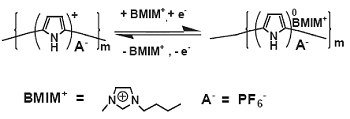
link to PDF on Science site pi-Conjugated polymers that are electrochemically cycled in ionic liquids have
enhanced lifetimes without failure (up to 1 million cycles) and fast cycle switching speeds (100 ms). We report results
for electrochemical mechanical actuators, electrochromic windows, and numeric displays made from three types of pi-conjugated
polymers: polyaniline, polypyrrole, and polythiophene. Experiments were performed under ambient conditions, yet the polymers
showed negligible loss in electroactivity. These performance advantages were obtained by using environmentally stable, room-
temperature ionic liquids composed of 1-butyl-3-methyl imidazolium cations together with anions such as tetrafluoroborate or
hexafluorophosphate. |
2001 |
act-CP |
 E. Smela and N. Gadegaard
J. Phys. Chem. B, 105 (39), 9395-9405 (2001)
[Abstract]
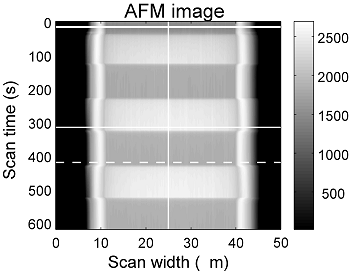
link to PDF on ACS site The electrochemically induced volume change in conjugated polymers is of interest for
actuator applications. Important parameters include the magnitude and speed of the volume change and how volume correlates with
potential and current. In this paper, atomic force microscopy was used to examine the expansion and contraction of films of
polypyrrole doped with dodecylbenzenesulfonate. The films were photolithographically patterned to allow the scan to start on
the substrate, go over the film, and return back to the substrate, giving an absolute height measurement. The method is
described in detail. This technique allowed us to map the real-time volume change in-situ in the out-of-plane direction,
which revealed that the film thickness increased by over 35% in the reduced state compared to the oxidized state. This
compares with an inplane strain of similar to2% found in prior studies using bilayers, showing that the volume change is
anisotropic. The thickness change was well-correlated with the cyclic voltammograms, and the polymer responded with a 3%/s
expansion for an applied reducing potential step. The height change depended on film thickness, with films near 1.5 mm
undergoing the greatest strain. The morphologies of the as-grown, oxidized, and reduced states were also examined, but
there were no substantial differences. The unexpectedly large out-of-plane strain was confirmed by in-situ mechanical
surface profilometry. These measurements also showed that the hardness of the reduced state was lower than that of the
oxidized state. |
2001 |
act-CP |
 S. Maw, E. Smela, K. Yoshida, P. Sommer-Larsen, and R. B. Stein
Sens. Act. A, 89, 175-184 (2001)
[Abstract]
link to PDF on Elsevier/ScienceDirect site Polypyrrole(dodecylbenzene sulfonate), a type of conjugated polymer that can
change volume under electrochemical stimulation, was electrochemically deposited on metal-coated Kapton strips
using current densities that ranged from 0.4 to 40 mA/cm2. The resulting bending beams were subjected to various
voltage and current stimulation waveforms, and the beam movements and electrochemical activity were recorded. The extent
of beam curling during cyclic voltammetry and potential stepping correlated inversely with deposition current density.
However, during current stepping, the curling did not depend on deposition current density. Rather, it depended only on the
amount of charge exchanged. |
2000 |
PLED |
 Y. Kaminorz, E. Smela, T. Johansson, L. Brehmer, M. R. Andersson,
and O. Inganäs
Y. Kaminorz, E. Smela, T. Johansson, L. Brehmer, M. R. Andersson,
and O. Inganäs
Synth. Met., 113 (1-2), 103-114 (2000)
[Abstract]
link to PDF on Elsevier/ScienceDirect site Surface light emitting diodes (SLEDs), in which previously microfabricated electrodes
were coated with a conjugated polymer, were made with greatly different electrode spacings (250 nm and 10 or 20 mm) and with
different electrode material combinations. The fabrication process allowed us to compare several electrode materials. The
SLED structures also enabled imaging of the light emission zone with fluorescence video microscopy. Conventional sandwich
structures were also made for comparison (electrode separation 50 nm). In this study, the emitting layer was
poly[3-(2',5'-bis(1'',4",7" trioxaoctyl)phenyl)-2,2'-bithiophene] (EO-PT), a conjugated polymer based on
polythiophene with oligo(ethyleneoxide) side chains. The current-voltage (I(V)) and light-voltage (L(V)) characteristics of
the SLEDs were largely insensitive to electrode separation except at high voltages, at which the current in the devices with
the largest separations was limited. Sandwich structures had the same light output at a given current. Light could be
obtained in forward and reverse bias from indium tin oxide (ITO)-aluminum, gold silicide-aluminum, and gold silicide-gold SLEDs,
but the turn-on voltages were lowest with the ITO-aluminum devices, and these were also the brightest and most reliable. Adding
salt to the EO-PT increased the current and brightness, decreased the turn-on voltages, and made the I(V) characteristics
symmetric; thus, a device with an electrode separation of 10 mm had the extraordinarily low turn-on voltage of 6 V. The location
of the light emission was at the electron-injecting contact. |
2000 |
act-CP |
 E. W. H. Jager, E. Smela, and O. Inganäs
Science, 290, 1540-1545 (2000)
[Abstract]
link to PDF on Science site
Conjugated polymer actuators can be operated in aqueous media, which makes them
attractive for laboratories-on-a-chip and applications under physiological conditions. One of the most stable conjugated
polymers under these conditions is polypyrrole, which can be patterned by means of standard photolithography. Polypyrrole-
gold bilayer actuators that bend out of the plane of the wafer have been microfabricated in our laboratory. These can be
used to move and position other microcomponents. Here we review the current status of these microactuators, outlining the
methods used to fabricate them. We describe the devices that have been demonstrated as well as some potential future applications.
Top of Page |
1999 |
act-CP |
 E. Smela, M. Kallenbach, and J. Holdenried
J. Microelectromech. Syst., 8 (4), 373-383 (1999)
[Abstract]
link to PDF on IEEE site
The conjugated polymer polypyrrole undergoes a volume change of several percent
when its oxidation state is changed electrochemically by the application of voltages between 0 and -1 V (versus Ag/AgCl).
This volume change is due to ion movements in or out of the polymer film. Bilayers of polypyrrole and gold undergo a large
bending and can deliver high force. They can thus function as hinges to lift rigid components. In this work, we demonstrate
that silicon plates produced by reactive ion etching can be lifted by such PPy/Au hinges. The strength and efficiency of
these bilayers are also determined. |
1999 |
act-CP |
 E. Smela and N. Gadegaard
Adv. Mater., 11 (11), 953-957 (1999)
[Abstract]
link to PDF on Wiley/InterScience site
The volume change in polypyrrole (PPy) films doped with the bulky
dodecylbenzenesulfonate (DBS) anion during redox reactions was measured directly using AFM. PPy patterned films
(1-1.5 mm) were grown on a gold layer (on a Si wafer coated with Cr) with the help of photoresists and in situ electrochem.
and AFM measurements were carried out. The potential was cycled between 0 and -1 V; freshly deposited PPy/DBS showed a
60-100% vol. increase during the first reduction. and a 30-40% change between oxidized and reduced states thereafter.
The volume change was highly anisotropic. |
1999 |
act-CP |
 E. Smela
Adv. Mater., 11 (16), 1343-1345 (1999)
[Abstract]
link to PDF on Wiley/InterScience site Polypyrrole (PPy) was doped with dodecylbenzenesulfonate and incorporated into a
micro-mechanical device together with e.g. Al, Au, Si. It is possible to supply power to devices fabricated on Si that
are moved out of plane of the wafer using a polymer actuator. Due to changes in dimensions of the doped PPy (caused by
electrochem. changes) the micro-mech. device (pixel) was moved. Possible applications are discussed. |
1999 |
act-CP |
 E. Smela
J. Micromech. Microeng., 9, 1-18 (1999)
[Abstract]
link to PDF on IOP site Conjugated polymers have a no. of interesting properties that can be exploited
in microfabricated sensors and actuators. For example, polypyrrole is a conjugated polymer that can change vol. to
deliver significant stresses and strains. These materials can be patterned using conventional microfabrication techniques.
The procedures for doing this are described in this paper, focusing on the microfabrication of polypyrrole microactuators.
In addition, other methods for the deposition and patterning of conjugated polymers are reviewed. A special technique for
releasing actuators, differential adhesion, is also detailed. |
1999 |
act-CP |
 E. W. H. Jager,
E. Smela, O. Inganäs, and I. Lundström E. W. H. Jager,
E. Smela, O. Inganäs, and I. Lundström
Synth. Met., 102 (1-3), 1309-1310 (1999)
[Abstract]
link to PDF on Elsevier/ScienceDirect site The doping and undoping of conjugated polymers is accompanied by a volume change.
This volume change can be used to make micro-actuators. We have built polypyrrole (PPy) gold bilayer structures.
The volume change of PPy induces a bending of the bilayer. We have made micro-actuators based on this principle, which
have been examined with video-microscopy. Some applications for these micro-actuators are proposed, including opening and
closing boxes for cell biology and nanoliter chemistry and micro-robotics. |
1999 |
act-CP |
 E. W. H. Jager, E. Smela, and O. Inganäs
Sens. Act. B, 56, 73-78 (1999)
[Abstract]
link to PDF on Elsevier/ScienceDirect site We present electrochemical microactuators which have all the electrodes necessary
for the actuation -- the working, counter, and reference electrodes -- on-chip. This is a first step towards an all-polymer
system, i.e., a system that does not require a liquid electrolyte. The microactuators' performance was as good as when standard,
off-chip counter and reference electrodes were used. Specifically, the speed of actuation was the same. In addition, we
obtained a good cyclic voltammogram, although the oxidation and reduction peaks were shifted and some noise was present.
Apart from application in an all-polymer system, we will also use these microactuators for studies on the effect of mechanical
stimulation of living cells. |
1998 |
SAM |
 E. Smela, G. Zuccarello, H. Kariis, and B. Liedberg
Langmuir, 14 (11), 2970-2975 (1998)
[Abstract]
link to PDF on ACS site link to supporting information
To try to solve the problem of delamination of polypyrrole from gold during
electrochemical cycling, 1-(2-thioethyl)pyrrole and 3-(2-thioethyl)pyrrole were synthesized as adhesion promoters.
These compounds were designed to bind to gold through the sulfur atom to form monolayers, and their alkyl chains were
made short to permit electron transfer to and from the pyrrole moieties. It was hoped that during electropolymerization of
unmodified pyrrole in solution, the pyrrole moieties of the monolayer would be incorporated into the growing film. In this
first paper of the series, the synthesis and characterization of the monomers and their electrochemical polymerization to form
thin films is presented. Nuclear magnetic resonance and infrared, Raman, UV-vis-NIR, and mass spectroscopy measurements form
a basis for comparison with monolayers adsorbed on gold surfaces in the following papers.
Top of Page |
1998 |
SAM |
 E. Smela, H. Kariis, Z. Yang, K. Uvdal, G. Zuccarello, and
B. Liedberg
E. Smela, H. Kariis, Z. Yang, K. Uvdal, G. Zuccarello, and
B. Liedberg
Langmuir, 14 (11), 2976-2983 (1998)
[Abstract]
link to PDF on ACS site link to supporting information
A combination of analytical techniques was used to examine monolayers of
1-(2-thioethyl)pyrrole (1-TEP) and 3-(2-thioethyl)pyrrole (3-TEP) adsorbed on gold, including infrared, UV-vis-NIR,
mass spectroscopy, ellipsometry, wetting, and X-ray photoelectron spectroscopy. Both monolayers were found to undergo
adsorption-catalyzed reactions. Monolayers of 1-TEP were disordered even after long deposition times, with an isotropic
distribution (orientation) of the tails, from perpendicular to parallel to the substrate, as expected for a short chain
thiolate with a relatively bulky tail group. Vapor and solution deposition methods produced the same results. The 1-TEP
monolayers were quite sensitive to oxygen, and exposure to air resulted in the rapid formation of carbonyl species. In the
bulk, 1-TEP did not react in this manner. Solution-deposited 3-TEP monolayers consisted predominantly of short-chain
alkanethiolates and/or disulfides that had lost the pyrrole moiety, together with ca. 30% of intact, bound 3-TEP. The
cleavage was not reflected in the ethanolic solutions, nor did the amount of intact 3-TEP on the surface decrease with
deposition time, so cleavage probably occurred upon adsorption. The intact 3-TEP molecules assumed a conformation with the
pyrrole rings essentially parallel to the substrate. A large carbonyl peak indicated that the 3-TEP oxidized even more quickly
than 1-TEP when exposed to air. |
1998 |
SAM |
 E. Smela, H. Kariis, Z. Yang, M. Mecklenburg, and B. Liedberg
Langmuir, 14 (11), 2984-2995 (1998)
[Abstract]
link to PDF on ACS site link to supporting information The electrochemical oxidation of 1-(2-thioethyl)pyrrole (1-TEP) and 3-(2-thioethyl)pyrrole
(3-TEP) monolayers on gold was studied. Their cyclic voltammograms were different, with, for example, 1-TEP having three
oxidation peaks and 3-TEP just one. Moreover, the cyclic voltammetry of bothTEPmonolayers was unusual and did not follow the
expected behavior for simple electron transfer from an adsorbed monolayer. The chronoamperometry for 1-TEP was also surprising,
showing nucleation-like peaks; this was not seen for 3-TEP. Air exposure left the 1-TEP, but not the 3-TEP, surface
electrochemically inert. Spectroscopic data on the oxidation products of surface-bound pyrroles are presented for the first time.
IRAS, XPS, andUV-vis-NIR showed that, after electrochemical cycling, all the pyrrole rings were absent. This demonstration that
the molecules decompose calls into question the generality of the graftingmechanism of adhesion promotion for this type of compound. |
1998 |
SAM |
 E. Smela
Langmuir, 14 (11), 2996-3002 (1998)
[Abstract]
link to PDF on ACS site
The electrochemical deposition of polypyrrole (PPy) potentiodynamically and
potentiostatically over monolayers of 1-(2-thioethyl)pyrrole (1-TEP) is described. The relationship between monolayer
oxidation and PPy growth depended strongly on the electrolyte. In propylene carbonate/LiClO4, the PPy polymerization
potential was higher than that for 1-TEP oxidation and the monolayer oxidation peak was identical to that seen in monomer-
free electrolyte. In water/LiClO4, the oxidation and polymerization potentials were almost the same, with the result that
the onset of polymerization was prevented until after the monolayer oxidn. process had been completed. In water/(sodium
dodecylbenzenesulfonate), an anionic surfactant, the polymerization potential was lower than that in water/LiClO4, and
polymerization apparently occurred without monolayer oxidation. In all cases, PPy growth was found to be essentially the
same on 1-TEP, oxidized 1-TEP, and clean gold as evidenced by cyclic voltammograms, chronoamperograms, and film appearance.
These results show that the 1-TEP monolayers probably decomposed before PPy polymerization began or were, in the case of
dodecylbenzenesulfonate sodium salt, most likely inaccessible because they were covered by the surfactant. This indicates
that 1-TEP cannot be used to covalently bind PPy to gold. These results also demonstrate that the general approach to
adhesion promotion through the use of thiol-modified pyrroles has conditions and limits that must be recognized. The
electrochem. of PPy grafting to surface-bound pyrrole depends critically on the electrolyte, which is important for
application of this technique in real devices. In addition, the oxidation reactions undergone by such a monolayer
cannot be assumed to be different in the absence and presence of pyrrole. Finally, the technique will probably not
work with surfactant anions, which are of most practical interest. The study was conducted in an attempt to try to
solve the problem of delamination of PPy from gold during electrochemical cycling, using (1-TEP) as adhesion promoter,
however, the results are not encouraging. |
1998 |
PLED |
 E. Smela, Y. Kaminorz, O. Inganäs, and L. Brehmer
Semicond. Sci. Tech., 13, 433 (1998)
[Abstract]
link to PDF on IOP site
Conjugated polymers are organic semiconducting materials that can emit light.
These polymers have the advantages of being light, cheap and easy to process, and in addition the band gap can be tailored.
We report the microfabrication of surface light-emitting diodes (SLEDs) on silicon substrates in which the electrodes are
underneath the organic electroluminescent layer. Patterned electrodes are separated by a 2500 A thick insulating layer of
silicon oxide or are interdigitated with a separation of 10 or 20 mm; the luminescent polymer is spin coated or solvent cast
on top of the electrodes. This fabrication method is completely compatible with conventional silicon processing because the
polymer is deposited last and the light is emitted from the upper surface of the diodes. Despite the large spacing between
electrodes, and despite the absence of an evapd. top contact, the voltages required for light emission were not much greater
than those used in conventional sandwich-type structures. The polymers used were poly(3-(4-octylphenyl)-2,2'-bithiophene)
(PTOPT) and polythiophene with oligo(ethylene oxide) side chains (EO-PT). |
1998 |
|
 S. Shimoda and E. Smela
Electrochim. Acta, 44 (2-3), 219-238 (1998)
[Abstract]
link to PDF on Elsevier/Pergamon site Polymerization and electrochemically induced volume change in polypyrrole doped with the
large aromatic surfactant anion dodecylbenzenesulfonate, PPy(DBS), were studied as a function of pH in unbuffered aqueous
solutions prepared by mixing DBS acid and NaOH. Volume change was measured during the first, anomalous reduction and in
subsequent cycles using a bending bilayer. The results differed completely from those obtained by others for PPy doped with
small, mobile anions. Films could be deposited potentiostatically at all nominal pH values between 1 and 11, but growth was
fastest at the lowest pH and uneven above pH 10 due to impaired nucleation. However, during potentiodynamic polymerization,
deposition and redox were easier at alkaline pH, having a smaller peak separation and greater charge density. At pH less than 3,
there were no reduction or oxidation (redox) peaks and the films became insulating. Contrary to expectations, the pH of the
growth solution did not affect the performance of the bilayer actuators, but the pH of the cycling solution was important.
Bending was fastest in alkaline solutions, although the degree of bending was the same at low and high pH. Except at very low
pH, two pairs of redox peaks could be distinguished in the cyclic voltammograms, with volume change restricted to the lower
potential pair associated with Na+ movement. There was no volume change associated with the anomalous current peak seen
during the first reduction scan, regardless of pH, but the films contracted during re-oxidation. Thereafter, during reduction
the films expanded to their original, as-grown volume. |
1998 |
sens-CP |
 D. Pede, E. Smela, T. Johansson, M. Johanssen, and O. Inganäs
Adv. Mater., 10 (3), 233 (1998)
[Abstract]
link to PDF on Wiley/InterScience site
A method is demonstrated of building microfabricated arrays of sensors based
on conjugated polymers focusing on optical imaging with a photodiode array. The photodiode array is assembled by
coating the bridge microstructure matrix with a conjugated polythiophene/C60 blend. An array of pixels formed by
perpendicular electrodes coated with a polymer layer is used. The upper and lower layers of electrodes have different
functions and are separated by an insulating layer where they cross. The deposition of the active material is achieved
by spin-coating or solvent-casting of a conjugated polymer. The results of using the bridge devices as chemical sensors
for detecting the distribution of I2 using a polymer layer which is oxidized by I2, and the possibility to derive bridge
structures to obtain electroluminescence, are briefly described.
Top of Page |
1998 |
|
 H. Kariis, E. Smela, K. Uvdal, M. Wirde, U. Gelius, and B. Liedberg
J. Phys. Chem. B, 102 (34), 6529-6538 (1998)
[Abstract]
link to PDF on ACS site
The adsorption of 3-(2-thioethyl)pyrrole (3-TEP) and 1-(2-thioethyl)pyrrole
(1-TEP) on gold has been studied in ultrahigh vacuum with infrared reflection absorption spectroscopy, X-ray
photoelectron spectroscopy, and temperature-programmed desorption mass spectroscopy. Depositions were made from
liquid phase at atmospheric pressure, from gas phase in ultrahigh vacuum: and from gas phase at atmospheric pressure.
Both molecules were found to chemisorb to the gold surface regardless of the deposition method. Most of the 3-TEP, however,
broke up, losing the pyrrole ring as it adsorbed on the surface. Both monolayers were sensitive to oxygen and oxidized
quickly if stored in air. Deposition of 1-TEP from solution or vapor in air gave a higher desorption peak temperature than
deposition from gas phase in UHV. The masses of the desorbing fragments that were detected from the heated monolayers were
smaller than those seen upon introducing 1-TEP gas into the UHV system, revealing that a partial decomposition of the
adsorbed molecules occurred prior to or at desorption. Some samples were electrochemically cycled to positive potentials to
investigate the stability of the monolayers. A large fraction of the 1-TEP and 3-TEP stayed on the surface when cycled to 0.8 V,
but some oxidation, fragmentation, and desorption were seen at higher potentials. |
1998 |
|
 Y. Kaminorz, E. Smela, O. Inganäs, and L. Brehmer
Adv. Mater., 10 (10), 765-769 (1998)
[Abstract]
link to PDF on Wiley/InterScience site Results from microfabricated LEDs with electrodes underneath the electroluminescent
layer (surface LEDs), here with a rectangular bottom ITO electrode separated by a 2500A thick insulating layer of SiO2 from
a comb-shaped top Al electrode, are reported. The luminescent polymer, poly[3-(2',5'-bis(1'',4'',7''-trioxaoctyl)phenyl)-
2,2'-bithiophene] (EOPT), was solvent cast on top of the electrode. The polymer-on-top configuration allowed the gases to
diffuse quickly into the film during device operation and enabled PL measurements on the same device. Electroluminescence
(EL) was quenched by oxygen, which also increased the electron current in EOPT. Removal of oxygen caused the EL to recover
and the current to fall again, but with different time constants. The quenching was not due to degradation. PL was
insensitive to oxygen alone, so excitons were not directly involved in the quenching mechanism. |
1995 |
LC |
 E. Smela and L. J. Martinez-Miranda
J. Appl. Phys., 77 (5), 1930-1933 (1995)
[Abstract]
link to PDF on AIP site
X-ray diffraction measurements were done on octylcyanobiphenyl (8CB) films on a
glass grating with a 9 mm period. The films were heated from the smectic to the isotropic phase using three different methods.
The cooling rate, which determines the time the mols. are able to respond to the influence of the air and substrate interfaces,
plays a critical role in the alignment of the liquid crystal molecules. In all cases, the surface tension was strong enough,
and the energy cost of an interface with a second alignment was high enough, to produce a single homeotropic alignment in films
as thick as 15 mm. |
1995 |
LC |
 E. Smela and L. J. Martinez-Miranda
J. Appl. Phys., 77 (5), 1923-1929 (1995)
[Abstract]
link to PDF on AIP site
X-ray diffraction measurements were performed on smectic A octylcyanobiphenyl liq.-crystal
(LC) films deposited on glass and Si gratings with periods between 664 nm and 200 mm. The film's two interfaces, air-LC and
LC-grating, imposed boundary conditions that required different alignments for the minimum energy configuration; the competition
between these two forces was studied in thick (3+ mm) films. Consistent with earlier work, gratings with periods approximately
10 mm and depths of 1.5-3 mm induced a portion of the film into homogeneous alignment in the direction of the grooves. As
expected from theory, longer-period 200 mm gratings with the same depth showed an inconsistent ability to produce an inplane
alignment; however, contrary to theory, shallower 664 nm gratings also failed to consistently induce in-plane alignment and
did not produce an azimuthal preference. The results from the x-ray scans were fit with a multilayer model to give estimates
of the thicknesses, orientations, and mosaic spreads of the different regions in the films. Films having an in-plane component
have a 5-10 mm thick homeotropic skin at the surface. On 9 and 15 mm gratings, the in-plane scattering arose from a single
homogeneous region in which the molecules had a small tilt (up to 5 degrees) with respect to the plane of the substrate. The
director was not exactly parallel to the grooves but was offset by up to 20 degrees, and the mosaic spread in the azimuthal
direction was typically 20 degrees. In some films there was an additional region that appeared to be disordered. |
1995 |
act-CP |
 E. Smela, O. Inganäs, and I. Lundström
Science, 268 (23 June), 1735-1738 (1995)
[Abstract]
link to PDF on JSTOR site Several types of microactuators were fabricated (from simple paddles to
self-assembling and -diassembling cubes). Conducting bilayers made of a layer of polymer and a layer of Au were used as
hinges to connect rigid plates to each other and to a Si substrate. The bending of the hinges was electrically controlled
and reversible, allowing precise 3-dimensional positioning of the plates. The structures were released from the substrate
with a technique based on differential adhesion. This method (which avoids the use of a sacrificial layer and allows the
actuators to pull themselves off the surface) may have general applications in micromachining. Possibilities include the
manufacutre of surfaces whose light reflection or chemical properties can be switched. |
1993 |
sens |
 K. Suga, N. Koshizaki, K. Yasumoto, and E. Smela
Sens. Act. B, 14 (1-3), 598-599 (1993)
[Abstract]
link to PDF on journal website
The gas-sensing characteristics of junction structures composed of Al2O3-doped
ZnO, NiO, and an intervening ultrathin SiO2 layer at the junction interface were investigated. An ultrathin intervening
SiO2 layer 30-60 nm thick at the junction interface gives high NO sensitivity and fast response time. A suitable
combination of component and intervening layer thickness will be important to obtain higher NO sensitivity.
Top of Page |
1993 |
LC |
 E. Smela and L. J. Martinez-Miranda
Liq. Cryst., 14 (6), 1877-1883 (1993)
[Abstract]
only available for a fee -- email me for a PDF copy
The authors have performed a structural study of the liq. crystal (LC)
octylcyanobiphenyl (8CB), deposited on gratings and flat surfaces, using high resolution x-ray scattering as a function
of film thickness. Glass was used as substrate and treated with either one of the organic surfactants MAP or DMOAP.
Competing with the LC-air interface, which is a strong aligner, a grating at the LC-substrate interface produces distortions
in the smectic layering with an excess of elastic energy, which favors alignment parallel to the substrate and the grooves.
The analysis confirmed the authors' earlier observations that surface tension at the air interface plays a dominant role in
the alignment of the LC molecules. |
1993 |
LC |
 E. Smela and L. J. Martinez-Miranda
J. Appl. Phys., 73 (7), 3299-3304 (1993)
[Abstract]
link to PDF on AIP site
Octylcyanobiphenyl, a bilayer smectic A liquid crystal at room temperature, was
deposited on gratings, grids, and flat surfaces, and was studied using high-resolution x-ray scattering at shallow angles of
incidence. One surface of the film was in contact with air and the other was in contact with the glass or Si substrate, which
had been treated with one of two different silane solutions. At the air interface, surface tension forces caused the liquid
crystal molecules to align perpendicularly with respect to the plane of the substrate. Competing with the liquid crystal-air
interface, which is a strong aligner, a grating at the liquid crystal-substrate interface can produce distortions in the smectic
layering, which results in excess elastic energy and favors alignment parallel to the substrate and the grooves. In films less
than ~30 mm thick, the homeotropic orientation was maintained throughout the film due to the constraint of perpendicular alignment
at the air interface. However, for thicker films on gratings, Bragg scattering from molecules lying parallel to the grooves
was observed. The free-air surface was thus the strongest aligning force, followed by the surface topography, while surface
anchoring was not found to play a role. |
1993 |
act-CP |
 E. Smela, O. Inganäs, Q. Pei, and I.
Lundström
E. Smela, O. Inganäs, Q. Pei, and I.
Lundström
Adv. Mater., 5, 630-632 (1993)
[Abstract]
link to PDF on Wiley site
Artificial fingers, bilayers of gold and polypyrrole (PPy) anchored at one end,
were fabricated on a Si wafer surface using microfabrication techniques and electropolymerization of pyrrole. In an aqueous
electrolyte the fingers curled upon reduction of PPy, the gold layer being neutral. The response time was ~5 seconds and they
operated for thousands of cycles. |
1993 |
act-CP |
 E. Smela, O. Inganäs, and I. Lundström
J. Micromech. Microeng., 3 (4), 203 (1993)
[Abstract]
link to PDF on IOP site
Microfabrication techniques allow one to construct metal/polymer bilayers anchored
at one end to a substrate and free to move at the other end. Electrically controlled "fingers" were fabricated
using the conducting polymer as an artificial muscle: doping and undoping the conjugated polymer causes a change in volume of
this layer which results in bending of the bilayer. Grasping hands, fingers with sensing tips, and micropumps can be envisioned.
Standing in the way of immediate fabrication are several materials challenges, including layer adhesion, material compatibility,
sacrificial layer improvement, and low-temperature processing techniques. |
1991 |
LC |
 E. Smela and L. J. Martinez-Miranda
Mol. Cryst. Liq. Cryst., 203, 1-8 (1991)
[Abstract]
only available for a fee -- email me for a PDF copy
The alignment of the free surface of a liquid crystal film as a function of depth
using grazing incidence x-ray diffraction was studied. Well defined gratings were produced on soda lime glass using
conventional photolithograpic treatment with MAP. The substrates induced homogeneous alignment with a preferred orientation
along the direction of the grooves in the bulk of an 8CB film in the smectic A phase at room temperature. At the air/liq.
crystal interface, these molecules align homeotropically. Using conventional Bragg diffraction, a layer spacing of 31.5 A
was observed for the perpendicularly aligned molecules near the surface. However, using a collimated beam in the grazing
incidence geometry at a nominal incident angle of 0.0 degrees, a diffraction peak with a large angular spread showed a layer
spacing of 40.1 A at the surface. The topmost layers are probably in the antiferroelectric smectic A2 phase, in which the
molecules lie head to head with a double layer spacing of approximately twice the molecular length. Because the SmA2 phase
is not stable in the bulk, it is either a surface or a grating induced effect. With increasing depth, the bulk bilayer
spacing is reestablished. |
1988 |
FO |
 E. Smela and J. J. Santiago-Aviles
Sens. Act., 13 (2), 117-129 (1988)
[Abstract]
link to PDF on ScienceDirect site
An optical sensor sensitive to changes in light absorption and other optical
interactions, and consisting of two fibers twisted around each other, is described. The sensor can be used as a
refractometer, is very sensitive to the presence of water in oil, can be used to determine the amount of a solvent in oil,
and might be useful in monitoring degradation of internal combustion engine oil. In addition, by surrounding the fibers with a
film of solution, and observing the changes in ouput over time, additional information can be obtained. Used in this manner,
the sensor can be used to identify specific solutions.
Top of Page |
Journal Papers |
Patents |
Book Chapters |
Conference Proceedings
Page last updated:
April 16, 2024
|